Etienne Psaila
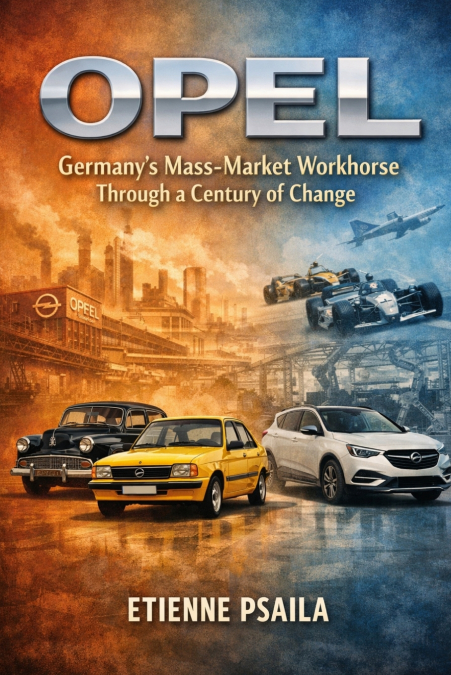
Opel’s history is a case study in what it takes to build ordinary mobility at extraordinary scale. From its industrial roots in Rüsselsheim to its emergence as one of Europe’s volume anchors, Opel repeatedly faced the same hard problem: how to turn engineering discipline into cars and commercial vehicles that typical households and fleets could actually afford-year after year, generation after generation-while the political and economic ground under Europe kept shifting.This book follows Opel through the defining forces that shaped the brand’s realities: mass production, labor and plant politics, export logic, selective motorsport credibility, and the constant pressure of the European market’s price sensitivity. It traces how Opel’s mainstream 'middle' was created, defended, and periodically redefined-through compact cars, family saloons, MPVs, vans, and later crossovers-while safety rules, emissions law, and cost control increasingly became product requirements rather than background constraints.Ownership change is treated as an operational fact with day-to-day consequences, not a headline. The narrative tracks what shifted-and what had to be rebuilt-under GM’s long stewardship, the rapid integration into PSA’s platform-and-procurement system, and the multi-brand calculus of Stellantis. Across these eras, the book keeps its focus where Opel’s story actually lives: factories, product planning, and the practical engineering habits that separate a durable mass-market carmaker from a company that only briefly catches a trend.The result is a fact-driven industrial and cultural history of a brand that rarely chased extremes, yet helped define the baseline of European motoring-proving that 'workhorse' is not a marketing slogan, but a manufacturing commitment measured in millions of vehicles, decades of incremental change, and the demanding economics of building for everyone.