Etienne Psaila
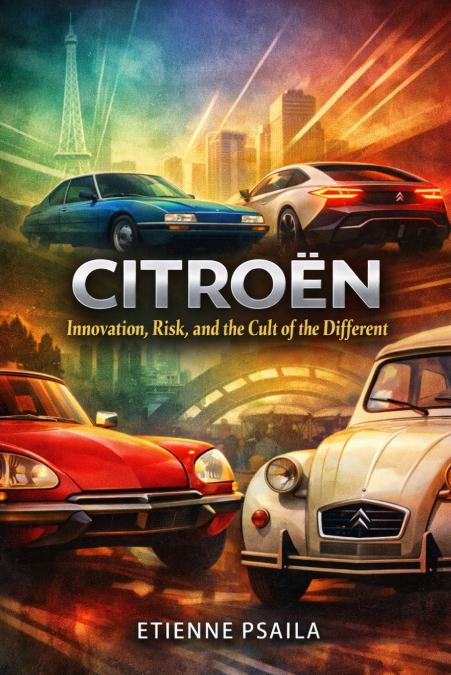
Citroën’s story is the rare corporate narrative where engineering choices are inseparable from cultural meaning. From André Citroën’s early industrial imagination to the brand’s most daring systems-led cars, the double chevron repeatedly treated 'ordinary mobility' as a platform for extraordinary ideas-front-wheel drive made practical at scale, comfort engineered as a measurable outcome, and design used as a public language of modernity. The result was not a straight-line march of progress, but a century-long rhythm of bold bets, hard lessons, and reinventions shaped by wars, oil shocks, regulation, and shifting ownership.This book follows Citroën as both manufacturer and mindset: how factories, labor politics, and production discipline enabled (and sometimes limited) creativity; how advertising and spectacle helped turn technology into mythology; and how global expansion forced the brand to translate Frenchness into export reality. Along the way, landmark models-Traction Avant, 2CV, DS, SM, CX, and the platform-era families that followed-serve as turning points in a larger argument: that 'different' is not a slogan unless it survives contact with cost, serviceability, and mass-market expectations.In the modern era of consolidation, the question becomes less romantic and more consequential: how does a brand built on distinct engineering continue to feel distinct inside shared architectures and electrification economics? Citroën’s answer-past and present-has been to defend comfort, usability, and character as legitimate engineering goals, even when the business case demands discipline.