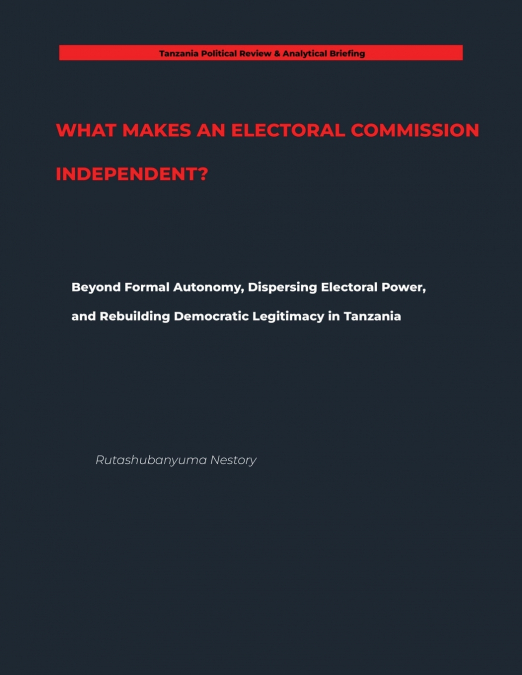
WHAT MAKES AN ELECTORAL COMMISSION INDEPENDENT?

WHAT MAKES AN ELECTORAL COMMISSION INDEPENDENT?

Rutashubanyuma Nestory.

32,79 €
IVA incluido
Disponible
Editorial:
Rutashubanyuma Nestory.
Año de edición:
2026
Materia
Elecciones y referendos
ISBN:
9798237221213
32,79 €
IVA incluido
Disponible
Añadir a favoritos

Electoral commission independence is widely regarded as a central institutional condition of electoral integrity, yet formal autonomy does not necessarily prevent the concentration of consequential electoral power elsewhere within the electoral system. This article examines Tanzania’s electoral architecture through the distinction between formal electoral autonomy and substantive electoral independence. Building on scholarship on electoral integrity, electoral malpractice, electoral-management-body independence and democratic institutional design, including the recent Tanzania-Kenya comparative analysis by Makulilo and Sulley (2026), the article argues that the conventional commission-centred approach does not fully capture the institutional sources of electoral vulnerability. Substantive independence depends not only upon whether an electoral commission is legally autonomous, but also upon how appointment, personnel, finance, territorial administration, technology, results management and judicial accountability are distributed and constrained across institutions.The article develops a power-architecture framework organised around four principles: the Non-Concentration Principle, the Collective Institutional Restraint Principle, the Territorial Electoral Neutrality Principle, and the Judicial Accountability Principle. These principles provide a framework for examining whether consequential electoral powers are dispersed sufficiently to prevent institutional capture or the substitution of one form of political control for another. The analysis is doctrinal, institutional and comparative. It examines Tanzania’s constitutional and statutory framework, including the 2024 reforms establishing the Independent National Electoral Commission, and places these developments in conversation with Tanzania’s earlier constitutional reform proposals and comparative experience in Kenya, South Africa, Ghana and Zanzibar. Kenya serves as the principal comparative test because its stronger constitutional and judicial safeguards demonstrate both the value and the limitations of institutional dispersal.The article argues that Tanzania’s 2024 electoral reforms represent a significant movement towards more structured electoral administration but do not, by themselves, redistribute all consequential electoral powers sufficiently to secure substantive independence. The argument is reinforced by the African Court on Human and Peoples’ Rights’ 2026 decisions concerning restrictions on judicial review of presidential-election results and electoral-commission decisions. Against this background, the article proposes a more dispersed Tanzanian institutional model centred on an Electoral Appointment Council, elected rather than nominated party delegates, an independent professional electoral secretariat, permanent and professionally administered territorial structures, protected financial and technological capacity, auditable results management, and effective domestic and continental judicial review. The article does not contend that institutional redesign can eliminate political contestation. Rather, it argues that democratic legitimacy is strengthened when political influence is made plural, transparent and legally constrained rather than concentrated within a single institutional centre.The article’s broader contribution is to reconceptualise electoral independence as a systemic constitutional condition rather than an attribute of the electoral commission alone. Electoral legitimacy, on this account, depends upon whether consequential electoral powers are sufficiently dispersed, restrained, transparent, auditable and reviewable to permit genuine political competition while preserving the constitutional values of democratic participation, national unity and institutional stability.
Artículos relacionados

  • In Search of the Next P.O.T.U.S.
    Judy M Frankel
    The U.S. Government is Broken! In Search of the Next POTUS (President of the United States) tackles the seemingly impossible task of making Congress work! In this true adventure, political activist Judy Frankel shows how to combat corruption in Congress while choosing a qualified leader for the White House. Her humorous and heartbreaking crusade to overhaul Washington from th...
    Disponible

    14,10 €

  • Invisible Treason in America
    John D. Trudel / Paul E. Vallely / Thomas McInerney
    Admiral Lyon’s Warning: CIA developed Hammer and Scorecard (a surveillance supercomputer) after 9/11. They used it to alter election results, and to spy on judges, Senate computers, and high-profile Americans. Lyons spoke with General McInerney two days before he passed away in December 2018. 'Tom, HAMMER is key to the coup.'Hillary’s Nightmare: Hammer assured her win. But CIA’...
    Disponible

    15,90 €

  • The Glory and the Burden
    Robert Schmuhl
    Robert Schmuhl chronicles the American presidency for nearly a century, providing a compelling picture of how the functions of the office and who occupies it have changed over the decades.The Glory and the Burden: The American Presidency from the New Deal to the Present is a timely examination of the state of the American presidency and the forces that have shaped it since 1933...
  • The Glory and the Burden
    Robert Schmuhl
    Robert Schmuhl chronicles the American presidency for nearly a century, providing a compelling picture of how the functions of the office and who occupies it have changed over the decades.The Glory and the Burden: The American Presidency from the New Deal to the Present is a timely examination of the state of the American presidency and the forces that have shaped it since 1933...
    Disponible

    24,27 €

  • Is This Any Way to Run a Democratic Election?
    Stephen J. Wayne
    ...
    Disponible

    85,17 €

  • Shock to the System
    Michael K. Miller
    How violent events and autocratic parties trigger democratic changeHow do democracies emerge? Shock to the System presents a novel theory of democratization that focuses on how events like coups, wars, and elections disrupt autocratic regimes and trigger democratic change. Employing the broadest qualitative and quantitative analyses of democratization to date, Michael Miller de...
    Disponible

    41,61 €

Otros libros del autor

  • The Unasked Question
    Rutashubanyuma Nestory.
    This book examines why the question of electoral validity was not expressly assigned to either of Tanzania’s presidential commissions of inquiry established after the contested 29 October 2025 general election. It distinguishes electoral occurrence, validity, and democratic legitimacy to argue that the central issue is not whether an election occurred, but how its constitutiona...
    Disponible

    16,48 €

  • TANZANIA AT THE CONSTITUTIONAL CROSSROADS
    Rutashubanyuma Nestory.
    Tanzania at the Constitutional Crossroads: Legitimacy, Political Trust, and Democratic Renewal After 2025 is a forty-chapter study of Tanzania’s political, legal, economic, and constitutional institutions in the aftermath of the 2025 general elections.The book brings together contemporary analysis and comparative inquiry around a common question: how can institutions retain leg...
    Disponible

    41,38 €

  • The Constitution on Trial Elite Rupture, Purge & Substitution in Contemporary Tanzania
    Rutashubanyuma Nestory.
    What happens when a constitution remains on the books, but the institutions responsible for giving it meaning come under increasing pressure?The Constitution on Trial takes readers inside the most consequential constitutional, political, and governance controversies confronting Tanzania during a period of extraordinary turbulence.From the expulsion of Vice President Emmanuel Nc...
    Disponible

    38,98 €

  • THE GAP BETWEEN LAW AND POWER Governance, Accountability, and Democratic Crisis in Tanzania’s Post-Election Era
    Rutashubanyuma Nestory.
    The Gap Between Law and Power: Governance, Accountability, and Democratic Crisis in Tanzania’s Post-Election Era examines Tanzania’s evolving governance crisis following the contested October 2025 general election.Through thirty-six chapters, the collection investigates the widening distance between formal legal protections and their practical enforcement, between institutional...
    Disponible

    32,85 €

  • THE TANZANIA CHRONICLES Governance, Justice, and the Quest for Democratic Renewal in the United Republic
    Rutashubanyuma Nestory.
    The Tanzania Chronicles: Governance, Justice, and the Quest for Democratic Renewal in the United Republic presents thirty-six interconnected essays examining Tanzania’s contemporary constitutional, political, legal, economic, and institutional challenges.Situated within the aftermath of the disputed October 2025 General Election, the collection investigates the widening gap bet...
    Disponible

    27,91 €

  • THE FLIP OF DEMOCRACY Essays on Governance, Power, and the Crisis of Constitutional Trust in East Africa
    Rutashubanyuma Nestory.
    The Flip of Democracy: Essays on Governance, Power, and the Crisis of Constitutional Trust in East Africa examines the institutional and constitutional challenges confronting Tanzania, Kenya, and Uganda during a period of profound political transformation.Drawing upon constitutional law, political theory, legal analysis, comparative governance, and empirical observation, the co...
    Disponible

    32,82 €