Rutashubanyuma Nestory.
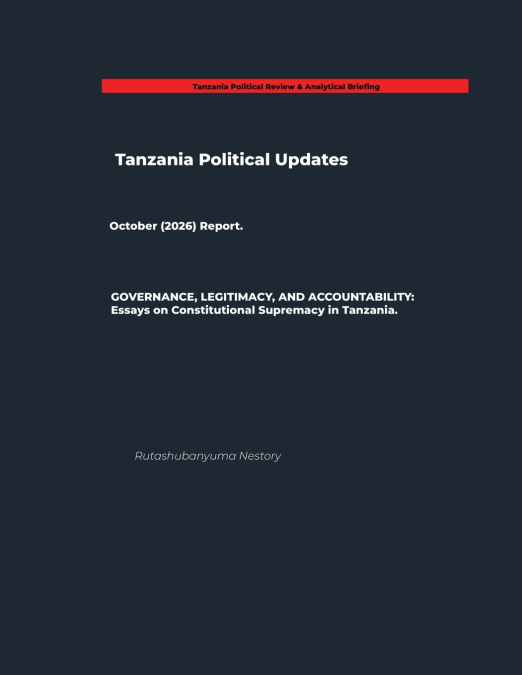
GOVERNANCE, LEGITIMACY, AND ACCOUNTABILITY:Essays on Constitutional Supremacy in TanzaniaWhen does political authority command lasting legitimacy, and what happens when constitutional courts recognize severe violations but stop short of providing remedies capable of reversing their consequences?This compelling volume investigates two defining crises in Tanzania’s contemporary governance that expose the fractures between formal legal authority, institutional independence, and public trust. The Contestation of Presidential Power: The first study unpacks the high-stakes political and semantic battle over the expressions Rais haramu (illegitimate president) and Rais batili (invalid president) in the wake of the highly contested October 2025 general elections. Moving beyond a mere linguistic dispute, the analysis examines political rhetoric, grassroots satire, and the reported institutional positions articulated by figures like Professor Palamagamba Kabudi. It fundamentally questions whether a state can restore its political legitimacy through vocabulary management while leaving structural grievances-such as electoral irregularities and unresolved accountability demands-unaddressed. The Limits of Judicial Remedies: The second study shifts the focus to the judiciary and the constitutional independence of the Controller and Auditor General (CAG). Through a rigorous critique of the landmark Court of Appeal judgment delivered on October 6, 2026, it analyzes the statutory dismantling of Professor Mussa Assad’s tenure in 2019 under Article 144(1) of the Constitution. While the Court delivered a monumental victory for constitutional supremacy by declaring the removal unconstitutional, it concurrently revealed its remedial limitations by refusing to order Assad’s reinstatement or invalidate the subsequent appointment of Charles Kichere. Though grounded in separate institutional arenas, these two studies converge on a singular, urgent thesis: the formal occupation of public office does not create political legitimacy, and the mere judicial recognition of an illegality does not guarantee institutional accountability. Bridging rigorous constitutional jurisprudence with sharp political inquiry, this volume is an essential text for scholars, jurists, policymakers, and political analysts. It serves as a stark reminder that public trust cannot be commanded through state narratives or restored by toothless declarations-it must be actively sustained by institutions that operate unflinchingly within the bounds of constitutional restraint.