Rutashubanyuma Nestory.
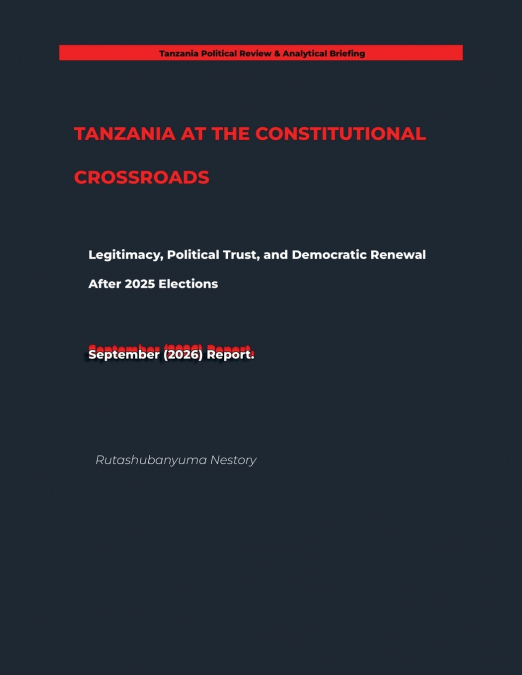
Tanzania at the Constitutional Crossroads: Legitimacy, Political Trust, and Democratic Renewal After 2025 is a forty-chapter study of Tanzania’s political, legal, economic, and constitutional institutions in the aftermath of the 2025 general elections.The book brings together contemporary analysis and comparative inquiry around a common question: how can institutions retain legitimacy when their formal authority is increasingly tested by political conflict, constitutional controversy, social pressure, and demands for accountability?The book is organised into four broad thematic parts:Part I - Commissions, Truth, and AccountabilityThis part examines commissions of inquiry, natural justice, institutional independence, post-election accountability, and the role of regional judicial participation. The central concern is whether an institution can credibly investigate allegations involving actors who possess significant political or institutional power.Part II - Executive Power and Constitutional LimitsThis part examines executive authority, constitutional constraints, citizenship, national security, political dissent, and comparative constitutional experience. The analysis asks when executive action remains within the sphere of legitimate administration and when it risks becoming a substitute for constitutional change or judicial determination.Part III - Criminal Justice, Rights, and Due ProcessThis part addresses self-defence law, evidentiary challenges, detention, contempt proceedings, professional freedoms, freedom of expression, and national-security legislation. The central proposition is that the legitimacy of criminal justice depends not only upon the existence of offences and enforcement powers but also upon legality, evidence, proportionality, procedural fairness, and effective judicial oversight.Part IV - Economy, Litigation, and Institutional CompetenceThis part extends the analysis into commercial and cross-border litigation, investment, confidentiality, critical minerals, corporate separateness, jurisdiction, and judicial procedure. It demonstrates that questions of institutional competence and procedural integrity do not disappear when disputes move from public law into commercial law.Methodologically, the book combines constitutional and statutory analysis, case-law examination, official reports, comparative jurisprudence, academic literature, civil-society documentation, and carefully attributed media reporting.Its method is deliberately consistent:identify the legal or institutional principle → establish the available evidence → distinguish fact from allegation and inference → examine the institutional response → assess the implications for legitimacy and accountability.This approach is particularly important when analysing politically contested events. A controversial outcome does not necessarily establish unlawful conduct; institutional association does not necessarily establish individual responsibility; chronology does not by itself establish causation; and formal legality does not automatically establish broader institutional legitimacy.The book is intended for scholars and students of African constitutionalism and governance, legal practitioners, civil society organisations, policymakers, journalists, and readers seeking to understand how institutional choices affect political trust.Completed in September 2026, the book records the law, cases, institutional developments, and events available to the author up to that point. Because several matters remain subject to litigation, investigation, political negotiation, or further institutional action, some conclusions are necessarily provisional.