Shane Larson
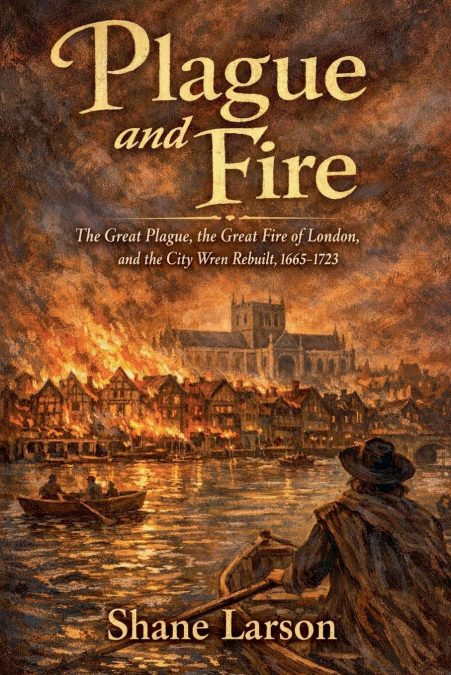
The Great Fire of London did not end the Great Plague. When the fire started, the plague had been dying out for nearly a year, and it had been worst in the suburbs outside the walls, which never burned.That is one of the most repeated facts in English history, and this book opens by taking it apart with the city’s own records. In 1665 the Bills of Mortality counted 68,596 plague deaths; the true toll was probably nearer a hundred thousand. Twelve months later, in the small hours of 2 September 1666, a fire in a Pudding Lane bakery met a dry summer and an east wind, and in four days burned some 13,200 houses, 87 parish churches, the Guildhall, the Royal Exchange and St Paul’s. Londoners read the two disasters as one judgment. Later generations decided the second had cured the first. Neither is what happened.Samuel Pepys stayed through both and wrote it down each night: the red crosses on the doors in Drury Lane, the grass growing in Whitehall court, the Lord Mayor saying he was spent and nobody would obey him, and the evening he buried his wine and a Parmesan cheese in the garden. Around him the book follows the searchers who counted the dead, the houses shut up for a month with a watchman at the door, the Derbyshire village of Eyam that sealed itself off, the homeless on Moorfields, and the watchmaker from Rouen hanged at Tyburn for starting the fire, on a confession the judges did not believe and against a ship’s master’s testimony that he had landed two days after it began.Then it tells the part most books treat as a postscript. A Fire Court without juries or lawyers’ delay settled well over a thousand property disputes. A Rebuilding Act made London a city of brick. And Christopher Wren, an Oxford astronomer who had designed a theatre, a chapel and very little else, was handed fifty-one churches and a cathedral and worked on them for the rest of a very long life. The book works from the seventeenth-century record, the diaries, the Bills, the plague orders, the Fire Court decrees, and where the numbers are contested, from the toll of 1665 to the fire’s six recorded deaths, it says so.What you’ll learn:Why the fire cannot have ended the plague, from the Bills, the map and the rest of EuropeHow a city counted its dead, and how John Graunt turned the count into statisticsWhat shutting up a house meant, who fled, and who stayedHow the fire moved, day by day and street by streetHow a Frenchman was hanged for a fire he arrived too late to start, and how the blame was cut into the Monument in 1681 and stayed until 1830Why none of the grand new street plans was adopted, and why that was rightHow Wren and Robert Hooke rebuilt fifty-one churches and St Paul’s, and how much was whoseThis book is for you if:You have read The Black Death and want the last great plague to visit EnglandYou know the Pepys diary and want the city around itYou have walked from the Monument to St Paul’s and want to know what you were looking atYou want the rebuilding as a story in its own right, not a closing chapterTwo disasters eighteen months apart, and the city that rose where the old one had stood. This is the whole story, from the first plague burial to Wren’s tomb.