Gigi Romano
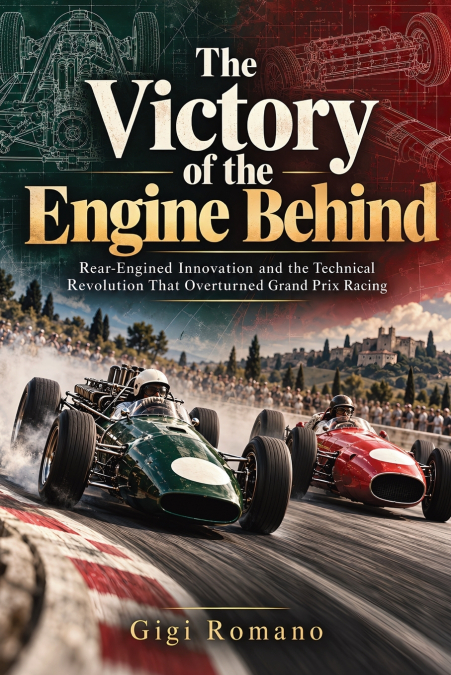
For decades, Grand Prix racing followed a familiar formula: powerful engines at the front, drivers behind them, and long mechanical structures built to translate horsepower into speed. Then a small British manufacturer challenged almost everything the established factories believed about building a winning racing car. The Victory of the Engine Behind explores the engineering revolution that transformed Formula One during the late 1950s and early 1960s, tracing the confrontation between Cooper’s lightweight rear-engined designs and Ferrari’s powerful front-engined Grand Prix machines. From Jack Brabham’s determined appearance at Monaco in 1957 to Stirling Moss’s extraordinary Argentine victory, the championship battles of 1959 and 1960, and Ferrari’s eventual adoption of the revolutionary layout, this book examines how racing’s competitive balance changed. Discover how Coventry Climax engines, compact chassis, weight distribution, suspension design, gearbox reliability and tyre strategy allowed smaller racing cars to challenge manufacturers with substantially greater resources. Follow the development of the Cooper T51 and Lowline, the final victories of Ferrari’s front-engined Dino, and the arrival of the celebrated rear-engined Ferrari 156. More than a history of race results, this is the story of how practical engineering overturned convention, how established manufacturers responded, and how an innovation became the foundation of modern Grand Prix design. Trademark and Independence Disclaimer: This is an independent, unofficial historical publication. It is not affiliated with, authorised, sponsored or endorsed by Formula One, Formula 1, the FIA, Ferrari, Cooper, Coventry Climax or any other organisation mentioned. All trademarks and names remain the property of their respective owners and are used solely for factual, historical and descriptive identification.