Gigi Romano
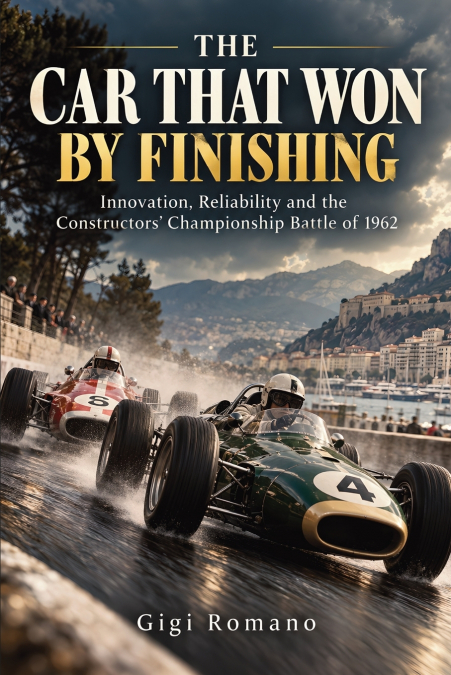
In 1962, Formula One witnessed a championship battle that would expose the difference between building the fastest racing car and building one capable of winning a world title. British Racing Motors and Lotus approached the challenge from opposing engineering directions. BRM relied upon the carefully developed P57, a conventional spaceframe chassis powered by its own ambitious V8 engine. Lotus introduced the revolutionary Type 25, whose lightweight aluminium monocoque would transform the future of Grand Prix car design. At the centre of the contest stood Graham Hill and Jim Clark, two exceptional drivers whose performances pushed their machines to the limits. From the demanding corners of Monaco to the high speeds of Monza, the season became a test of engineering ingenuity, mechanical endurance and the unpredictable consequences of even the smallest failure. The Car That Won by Finishing examines the remarkable 1962 championship through the machines, engineers, drivers and decisions that shaped it. Exploring engine development, chassis construction, suspension design, transmission problems and race-by-race competition, Gigi Romano reveals how BRM secured the championship while Lotus introduced a technology destined to redefine Formula One. The dramatic finale in South Africa would demonstrate that an extraordinary racing car could lose everything through a seemingly insignificant mechanical defect, while a more mature rival could turn speed, preparation and reliability into championship glory. This is the story of two constructors, two engineering philosophies and a season in which winning the championship and changing the future of racing proved to be very different achievements. Disclaimer: This is an independent, unauthorised historical and technical publication. It is not affiliated with, endorsed by or sponsored by Formula One, Formula 1, F1, BRM, Lotus, their successors or any other organisation mentioned. All trademarks, team names and product names belong to their respective owners and are used solely for historical identification and commentary. The author and publisher have made reasonable efforts to ensure factual accuracy, but historical accounts and technical specifications may vary between sources.