MD Ramon C. Henson
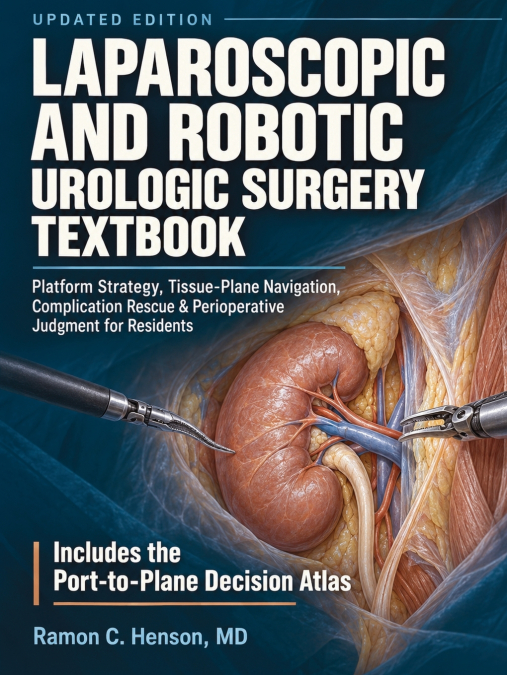
Translate Operative Geometry into Safer Urologic Decisions This clinical reference connects patient selection, access strategy, spatial anatomy, dissection planes, reconstruction, rescue, and recovery across contemporary minimally invasive urology. Written for residents developing operative judgment, it follows the full arc from platform setup and port placement through adrenal, renal, ureteral, prostate, bladder, retroperitoneal, pediatric, and female pelvic procedures. Each chapter treats laparoscopy and robotics as tools serving anatomic control, functional preservation, and the intended treatment objective. The reader gains a repeatable method for recognizing when exposure is adequate, when tissue behavior signals danger, and when a different access route better protects the patient. Clinical capabilities developed throughout the text include: Access planning, positioning, port geometry, and docking - align the operative workspace with the most demanding maneuver Retroperitoneal and pelvic anatomy - recover reliable landmarks when obesity, inflammation, prior treatment, or tumor distorts the field Energy, imaging, and instrument selection - match device behavior to tissue, target depth, and adjacent-structure risk Renal, adrenal, ureteral, prostatic, bladder, and nodal procedures - connect indication with dissection, control, reconstruction, and verification Hemorrhage, visceral injury, urine leak, stricture, and equipment failure - recognize deterioration early and escalate through a prepared rescue pathway Functional, oncologic, and recovery outcomes - assess quality beyond operative time, incision count, or platform completion Credentialing, video assessment, registries, cost, and digital innovation - adopt technology through transparent evidence and accountable governance Use this volume to prepare cases, articulate operative decisions, strengthen team coordination, and analyze outcomes with disciplined clinical reasoning.