MD Ramon C. Henson
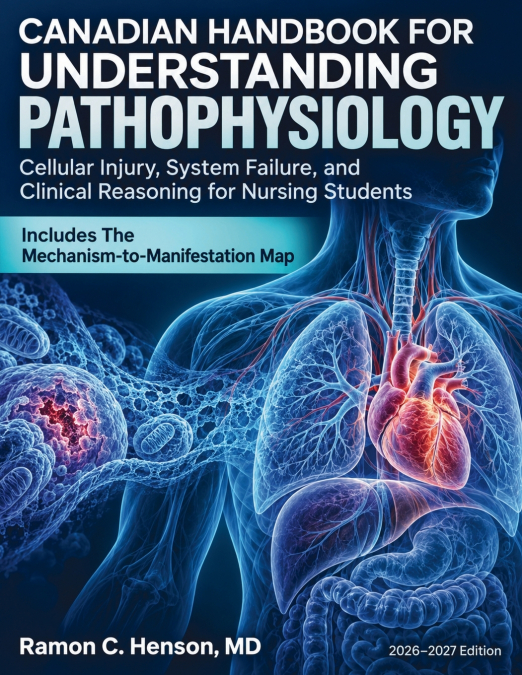
Trace Disease from Disruption to Bedside Findings This 2026-2027 clinical handbook connects altered cellular function, compensation, organ dysfunction, and observable patient findings across the major body systems. Written for nursing students and early-career clinicians, it develops a mechanism-first approach to assessment while addressing Canadian care settings, interprofessional communication, rural and remote access, population diversity, and local formulary verification. Coverage progresses from cellular injury, genetics, inflammation, immunity, infection, and cancer to organ-system disease, lifespan vulnerability, environmental injury, and integrated critical illness. Readers learn to interpret symptoms, examinations, laboratory trends, imaging, and physiologic monitoring as parts of one causal sequence rather than isolated facts. Each chapter pairs physiologic explanation with clinical correlation, narrative reasoning, visual prompts, and explicit thresholds for reassessment or escalation. Develop the clinical capabilities to: Connect homeostasis, reserve, feedback, and allostasis to early deterioration and decompensation Differentiate reversible cellular stress from membrane failure, regulated death, inflammation, fibrosis, and irreversible tissue loss Relate immune dysfunction, infection, sepsis, neoplasia, and hemostatic imbalance to recognizable clinical trajectories Interpret fluid, electrolyte, acid-base, cardiac, respiratory, renal, gastrointestinal, hepatic, endocrine, neurologic, and musculoskeletal disturbances Use narrative cases and numbered decision pathways to prioritize stability, localization, reversible threats, and escalation Recognize pregnancy, pediatric, aging, environmental, toxic, and critical-illness modifiers of physiologic reserve Apply The Mechanism-to-Manifestation Map through normal set points, primary disruptions, propagation chains, observable signals, clinical pivots, and failure thresholds Build a durable method for explaining disease progression, interpreting changing patient data, and communicating care priorities with precision.