Etienne Psaila
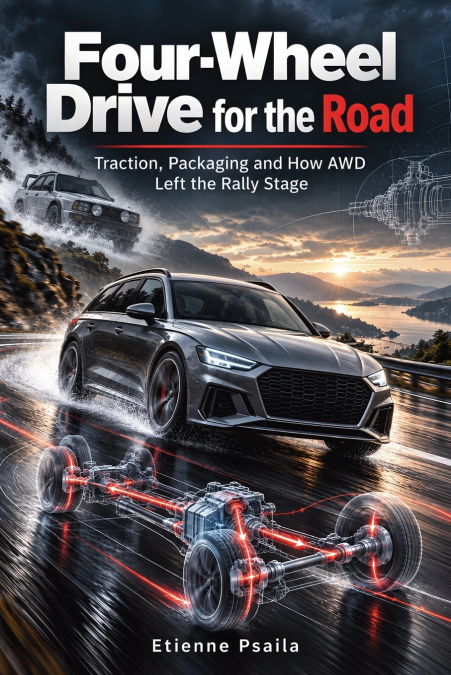
Four-wheel drive was once associated with rugged utility vehicles and difficult terrain. Today, it can be found beneath family estates, powerful saloons, everyday crossovers and electric cars. How did a specialised mechanical solution become such a familiar part of modern motoring? Four-Wheel Drive for the Road explores the engineering breakthroughs, historical developments and changing expectations that brought all-wheel drive into the mainstream. From early passenger-car experiments and Audi’s quattro revolution to the influence of international rallying, the book traces how manufacturers learned to distribute engine power between both axles without sacrificing the refinement and practicality expected of road cars. Discover how differentials, mechanical locking, automatic couplings and electronic torque vectoring work, why AWD can improve acceleration without guaranteeing shorter braking distances, and how tyre technology, weight, efficiency and packaging determine its real-world value. The story continues into hybrid and fully electric vehicles, where independently driven axles are changing the architecture of four-wheel drive once again. Written in accessible language for motoring enthusiasts and curious readers, this is a comprehensive account of the technology that transformed how cars put power onto the road. Disclaimer: This is an independent, unofficial work of automotive history and engineering commentary. All manufacturer names, vehicle models and trademarks mentioned, including Audi and quattro, belong to their respective owners and are used solely for factual, historical and descriptive purposes. No affiliation, sponsorship, authorisation or endorsement is implied. Technical information is provided for educational purposes and is not a substitute for manufacturer guidance or professional vehicle-safety advice.