Amodio Tortora
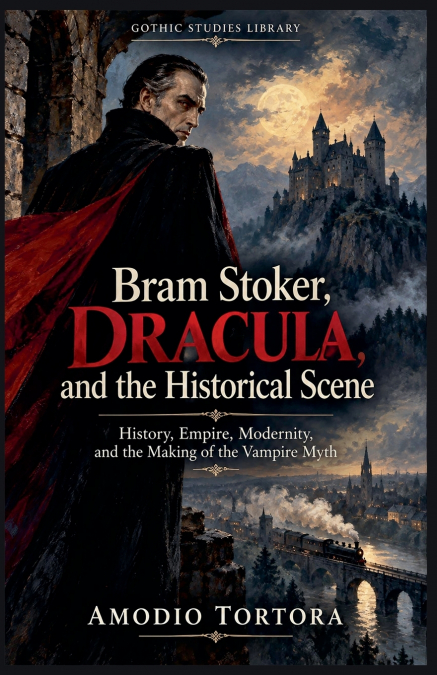
Unpublished work - First edition: Year 2026.Bram Stoker, Dracula, and the Historical Scene examines Dracula as a Gothic work created at the intersection of history, modernity, empire, science, gender, and cultural memory. The study argues that Stoker’s vampire gains his power from the collision of incompatible worlds: medieval warfare and modern property law, folklore and medicine, aristocratic lineage and professional expertise, the castle and the railway. Dracula becomes the figure through whom the Victorian present confronts a past that refuses to remain safely past.The book reconstructs Stoker’s historical context, from his Irish upbringing and Trinity College education to his career with Henry Irving at London’s Lyceum Theatre. Rather than treating biography as a simple key to the novel, it shows how Stoker’s experience of bureaucracy, theatre, journalism, travel, Ireland, and imperial Britain contributed to the conditions from which Dracula emerged.It then investigates the novel’s composition and sources. Stoker’s surviving notes reveal a method based on research, selection, and recombination: vampire literature, Gothic fiction, travel writing, Eastern European folklore, historical fragments, maps, and geographical studies were transformed into a new fictional system. It also challenges the exaggerated connection between Count Dracula and Vlad III. Stoker encountered the name 'Dracula' and fragments of regional history, but his vampire cannot be treated as a fictional biography of Vlad the Impaler. The distinction shows how fiction can reshape historical memory.Successive chapters place Dracula within the Gothic tradition and fin-de-siècle anxieties. The Count’s migration to England is examined through empire, invasion, degeneration, migration, and 'reverse colonization,' without reducing him to a single allegory. Science and superstition are not simple opposites: the hunters succeed by combining medicine and technology with documentary evidence, folklore, and religious knowledge.Gender and sexuality provide another perspective. Lucy, Mina, the female vampires, and the male hunters are read against debates over the New Woman, desire, masculinity, and women’s changing roles. Mina’s technical and analytical skills make her indispensable even while she remains surrounded by conventional ideals of femininity; the novel thus both destabilizes and attempts to restore established gender norms.The geographical analysis distinguishes historical Transylvania from Stoker’s Gothic construction, assembled at a distance from travel books, folklore, maps, and imaginative synthesis. London, however, proves that Gothic danger cannot be confined to a remote East. Its property market, railways, newspapers, communications, crowds, and anonymity provide Dracula with the infrastructure of invasion. His enemies respond by turning scattered evidence into a collective archive.Finally, the book follows Dracula beyond 1897 into theatre, cinema, criticism, tourism, and popular mythology. From Nosferatu and Bela Lugosi to Hammer, Christopher Lee, and later reinterpretations, adaptation produces a composite Dracula often different from Stoker’s Count. The fusion of the fictional vampire with Vlad III and the tourist mythology of Transylvania show how cultural memory can reverse the relationship between history and fiction. The study concludes that Dracula’s durability depends upon transformation: Stoker turned historical fragments into Gothic myth, while later culture turned that myth back into apparent history. Dracula survives because successive periods can give him new forms through which to renegotiate the boundaries between past and present, rational and irrational, self and Other, history and myth.