Peter Caldwell
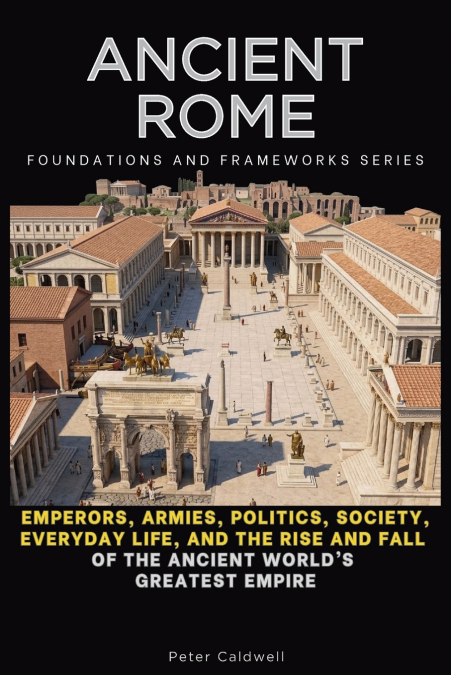
Ancient Rome history, told in order and in plain language: how a hilltop village of farmers grew into a state of sixty million people, how it ran day to day, and how its western half came apart. The book follows Rome in the sequence the Romans lived it, so each chapter builds on the one before. It also tells you when the evidence is solid, when a number is a best estimate, and when historians still disagree. Comparison tables lay out the ancient writers, the seven kings, and other names and dates side by side, so you can check a fact in seconds instead of flipping back through pages. Chapters walk through: - The founding myths of Aeneas and Romulus, checked against Iron Age huts on the Palatine and the Lapis Niger inscription - How historians read Livy, Polybius, inscriptions, coins, and excavated post holes - Consuls, the Senate, tribunes, and the Punic Wars, including Hannibal’s victory at Cannae - Marius, Sulla, Spartacus, Pompey, and Julius Caesar at the Rubicon - Augustus and the one-man rule he dressed up as a restored Republic - Julio-Claudians, Flavians, the adoptive emperors, and the Severans - The legion down to the eight-man contubernium, plus marching camps, siege engineering, and Hadrian’s Wall - Provincial taxes, Roman civil law, Caracalla’s grant of citizenship in 212 CE, and the grain ships from Egypt - Patronage, slavery and freedmen, the paterfamilias, and women’s property rights - Insulae, street food, public baths, aqueducts, gladiators, and the buried towns of Pompeii and Herculaneum - Household gods, Isis and Mithras, early Christianity, and Virgil, Ovid, Seneca, and Tacitus - The third-century crisis, Diocletian, Constantine, the sack of 410, and the last western emperor in 476 Each chapter closes with a discussion question, and the back of the book gives sample answers so you can test your own reasoning. A detailed timeline keeps twelve centuries in order, a glossary defines Latin terms such as cursus honorum and manumission, and the reading lists point you to your next explorations. Written for: - High school and college students in a classics or Western civilization course - Homeschool families who want a structured Roman history text - Teachers who need a ready reference with discussion prompts - Book clubs that want a history title with built-in discussion questions - Adult readers who toured the Colosseum and want the full story behind it or are simply fascinated by ancient Rome You get the famous moments, such as Caesar’s murder and Nero’s fire, set inside the system that made them possible: the taxes, the courts, the grain dole, and soldiers who signed up for twenty-five years. Every chapter stands on its own, so you can read straight through or jump to the part you need. Either way, you finish with a clear and honest picture of how Rome worked.