Peter Caldwell
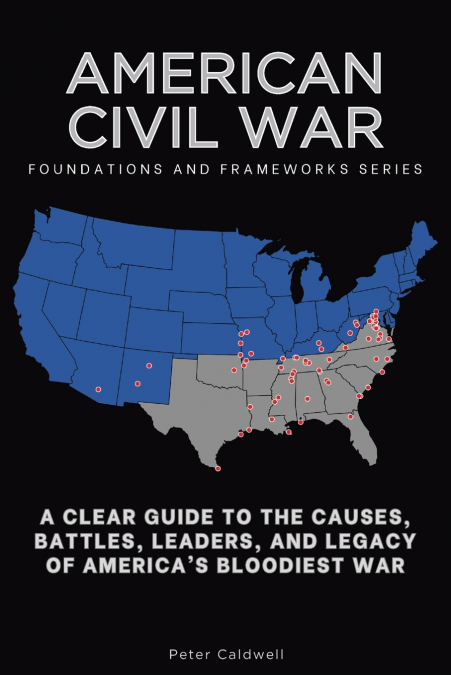
The American Civil War makes sense when you learn it in order: why it started, who fought it, how it was won, and what it changed. This book takes you from the cotton economy of the 1850s to the Compromise of 1877 in plain language. Ten chapters build one layer at a time, and each assumes only what earlier chapters covered. You need no background to start, and you finish with a solid grasp of the people, places, and decisions that reshaped the United States. The numbers alone show the scale: about 750,000 soldiers dead, roughly 2 percent of the population, and nearly 4 million people freed from slavery. The ten chapters walk through: - The Missouri Compromise, the Compromise of 1850, Bleeding Kansas, Dred Scott, and John Brown’s raid on Harpers Ferry - Lincoln’s four-way election in 1860, the failed Crittenden Compromise, Fort Sumter, and the secession of eleven states - A side-by-side look at Northern and Southern resources: population, factories, railroads, border states, the Anaconda Plan, and King Cotton diplomacy - Lincoln and Davis, Lee and his lieutenants, Grant and Sherman - The Union’s long search for an eastern commander, from McClellan to Meade - Shiloh, Antietam, Gettysburg, and Vicksburg - The Overland Campaign, the siege of Petersburg, Sherman’s March to the Sea, and the final week at Appomattox - How a fight to save the Union became a fight to end slavery, from the Emancipation Proclamation to the 180,000 Black men who served in the United States Colored Troops - Life away from the front: the New York City draft riots, greenbacks and the first federal income tax, battlefield medicine before germ theory, women’s wartime work, and Andersonville - Reconstruction, the Thirteenth, Fourteenth, and Fifteenth Amendments, and the long argument over how the nation remembers 1861 to 1865 Each chapter ends with questions that ask you to interpret evidence, connect events, and defend a position. Example responses in the back show one well-supported way to answer each. You also get: - A full timeline of the conflict - A plain-language glossary - Works Cited, plus a recommended reading list of one-volume histories, biographies, and single-battle accounts The book quotes primary documents directly, including the secession declarations of Mississippi and South Carolina, so you can read what people said in their own words and draw your own conclusions. Written for: - High school and college students taking U.S. history - Adult learners starting from zero - History buffs who want the entire conflict in one volume - Teachers and homeschool parents planning a unit Read it straight through for the full story, or jump to the chapter you need and use the timeline and glossary to fill gaps. Either way, four years of politics and more than 10,000 armed clashes become a story you can follow, explain, and remember.