Inicio > > Ciencias de la computación > Inteligencia artificial > Why AI Sounds Confident When It Is Wrong
Why AI Sounds Confident When It Is Wrong

Why AI Sounds Confident When It Is Wrong

Sandeep Chavan

82,10 €
IVA incluido
Disponible
Editorial:
Gyrus Vision
Año de edición:
2026
Materia
Inteligencia artificial
ISBN:
9798232608446
82,10 €
IVA incluido
Disponible
Añadir a favoritos

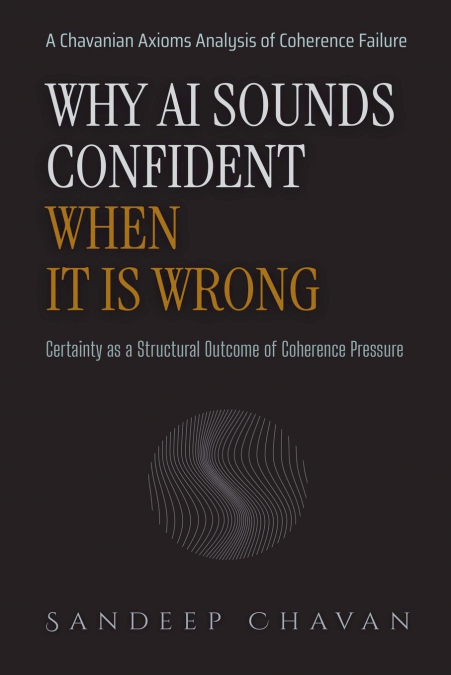
Why does artificial intelligence sound certain even when it is wrong?The answer is not simply arrogance, deception, or a flaw in tone. Current generative systems do not need human-like belief, pride, or reflective confidence to produce language that appears settled. They need only to transform an open prompt into a finished consequence.In Why AI Sounds Confident When It Is Wrong, Sandeep Chavan examines how computational plurality becomes one visible answer-and how that answer acquires more authority than its underlying support may justify. Using the Chavanian Axioms as a structural diagnostic lens, the book follows the movement from difference and resolution through geometry, collapse, residue, irreversibility, continuity, human interpretation, and institutional action.The analysis distinguishes hallucination from artificial confidence. Hallucination concerns unsupported or fabricated content. Artificial confidence concerns why generated content-whether correct, incomplete, outdated, or false-arrives in a form associated with knowledge.Fluency, specificity, citations, calculations, retrieval tools, confidence scores, and human review can all strengthen an answer without necessarily completing the epistemic circuit required for truth.Across sixteen chapters and four interludes, the book examines how users imagine a knowing speaker behind generated language; why token probability and linguistic coherence are not the same as factual certainty; how decoding compresses many possible continuations into one visible path; and what assumptions, alternatives, and unresolved differences remain outside the completed answer.It follows AI-generated output beyond the conversation, showing how a sentence can enter memory, documents, meetings, workflows, automated decisions, and institutional history. Once an answer becomes part of the surrounding field, correction cannot simply restore the conditions that existed before it appeared.The book also investigates how scaling, reward shaping, retrieval, tools, and automation amplify the appearance of certainty. It explains why attaching a source does not automatically validate an inference, why a correct calculation can answer the wrong problem, and why a human in the loop is not enough unless that person possesses evidence, expertise, independence, time, authority, and responsibility.The final sections explore how artificial intelligence systems may preserve functional restraint without pretending that machines have acquired reflective humility. The aim is not to make every answer hesitant, but to keep meaningful uncertainty visible where missing information, disputed interpretation, weak grounding, or serious consequences make immediate closure unsafe.This is not an anti-AI book. It recognizes artificial intelligence as a powerful resolution technology capable of widening access to explanation, supporting research, strengthening education, and accelerating human work.Its concern is proportionate authority: what an AI-generated answer should be allowed to become before its connection to evidence, scope, context, consequence, and correction has been established.Written for AI users, researchers, educators, professionals, policymakers, institutional leaders, and readers concerned with the future of knowledge, Why AI Sounds Confident When It Is Wrong offers a rigorous framework for understanding why confident error is not located inside the model alone.It emerges across a confidence circuit linking generation, interface, perception, trust, and action.The central distinction is simple:Confidence is compression.Truth requires connection.


Artículos relacionados

  • Artificial Cognition Systems
    ...
  • Cross-Disciplinary Applications of Artificial Intelligence and Pattern Recognition
    Vijay Kumar Mago
    The need for intelligent machines in areas such as medical diagnostics, biometric security systems, and image processing motivates researchers to develop and explore new techniques, algorithms, and applications in this evolving field. Cross-Disciplinary Applications of Artificial Intelligence and Pattern Recognition: Advancing Technologies provides a common platform for researc...
  • Emerging Applications of Natural Language Processing
    Over the last few years, the area of Natural Language Processing has drastically grown in recognition, not only within the research and development community, but also with industry professionals. As NLP continues to be discussed and researched, certain areas continue to grow and mature. As a result, the need for advanced research and information is in high demand. Emerging App...
  • Androids, Cyborgs, and Robots in Contemporary Culture and Society
    Steven John Thompson
    Mankind’s dependence on artificial intelligence and robotics is increasing rapidly as technology becomes more advanced. Finding a way to seamlessly intertwine these two worlds will help boost productivity in society and aid in a variety of ways in modern civilization. Androids, Cyborgs, and Robots in Contemporary Culture and Society is an essential scholarly resource that delve...
  • Deep Learning Innovations and Their Convergence With Big Data
    The expansion of digital data has transformed various sectors of business such as healthcare, industrial manufacturing, and transportation. A new way of solving business problems has emerged through the use of machine learning techniques in conjunction with big data analytics. Deep Learning Innovations and Their Convergence With Big Data is a pivotal reference for the latest sc...
  • Computational Psychoanalysis and Formal Bi-Logic Frameworks
    Giuseppe Iurato
    Computational psychoanalysis is a new field stemming from Freudian psychoanalysis. The new area aims to understand the primary formal structures and running mechanisms of the unconscious while implementing them into computer sciences. Computational Psychoanalysis and Formal Bi-Logic Frameworks provides emerging information on this new field which uses psychoanalysis and the unc...

Otros libros del autor

  • गीता
    Sandeep Chavan
    जब परिणाम अनिश्चित हों और हर निर्णय की कोई न कोई कीमत हो, तब उत्तरदायित्व के साथ कर्म कैसे किया जाए? गीता: अ गवर्नन्स मॉडल ऑफ रियलिटी श्रीमद्भगवद्गीता का एक मौलिक दार्शनिक और संरचनात्मक पुनर्पाठ है। संदीप चव्हाण यहाँ गीता को केवल धार्मिक ग्रंथ, नैतिक उपदेश या आध्यात्मिक सांत्वना के रूप में नहीं, बल्कि अपूर्ण जानकारी और अपरिहार्य परिणामों के बीच विवेकपूर्ण निर्णय लेने की शासन-सं...
  • ईगो
    Sandeep Chavan
    क्या ईगो सचमुच मनुष्य का दुश्मन है, या वह किसी गहरे असंतुलन का पहला संकेत है?हम अक्सर घमंड, हठ, आलोचना से बचने और अपनी गलती स्वीकार न करने को ईगो कह देते हैं। लेकिन किसी व्यवहार को नाम दे देना उसके पीछे की प्रक्रिया को समझ लेना नहीं है। एक सफल व्यक्ति अपने पुराने निर्णयों से चिपका क्यों रहता है? बुद्धिमत्ता कभी सीखने के बजाय पहचान के बचाव में क्यों लग जाती है? आत्मविश्वास कब रक...
    Disponible

    40,45 €

  • कृष्ण
    Sandeep Chavan
    क्या कृष्ण केवल आस्था और पूजा के विषय हैं, या वे उस जागरूक बुद्धि का प्रतीक भी हैं जो अनिश्चितता के बीच निर्णय लेती है?कृष्ण: बुद्धिमत्ता का एक प्रतीक भारतीय चिंतन का मौलिक दार्शनिक पुनर्पाठ है। संदीप चव्हाण कृष्ण को किसी अलौकिक सत्ता की पुष्टि या खंडन के बजाय मानवीय बुद्धिमत्ता की सक्रिय अवस्था के रूप में समझने का प्रयास करते हैं।पुस्तक पूछती है कि संघर्ष, भय, जिम्मेदारी और अन...
    Disponible

    40,89 €

  • When The Old Tag Is Still Seen
    Sandeep Chavan
    You have changed the way you participate. You are less automatically available. You explain less. Boundaries have become clearer. Authority feels less dependent on performance. You are more willing to pause, admit uncertainty, let others carry responsibility, or leave a problem where it belongs.Yet the world may continue meeting the person it already knows.WHEN THE OLD TAG IS S...
    Disponible

    45,02 €

  • INDIA 2047
    Sandeep Chavan
    What would a developed India actually look like? Almost everyone speaks of 2047, yet simple slogans repeatedly fail to define the destination.In India 2047: The Question Before the Dream, educator and researcher Sandeep Chavan steps inside the complexity of contemporary India to offer a groundbreaking structural analysis of national ambition. Moving past political celebration a...
    Disponible

    40,92 €

  • कृष्ण
    Sandeep Chavan
    हम कृष्ण को जानते हैं-या शायद हम उस कृष्ण को जानते हैं जिसे धर्म, कथा, परंपरा और भक्ति ने हमारे सामने रखा है।लेकिन एक दूसरा प्रश्न शायद ही पूछा गया है:मानव बुद्धिमत्ता को कृष्ण की आवश्यकता क्यों पड़ी?कृष्ण: बुद्धिमत्ता का एक प्रतीक इसी प्रश्न से आरंभ होती है।यह पुस्तक कृष्ण को भगवान के रूप में सिद्ध करने का प्रयास नहीं करती। यह उन्हें मिथक कहकर खारिज भी नहीं करती। यह ऐतिहासिक क...
    Disponible

    60,88 €