Alexander Val Watt
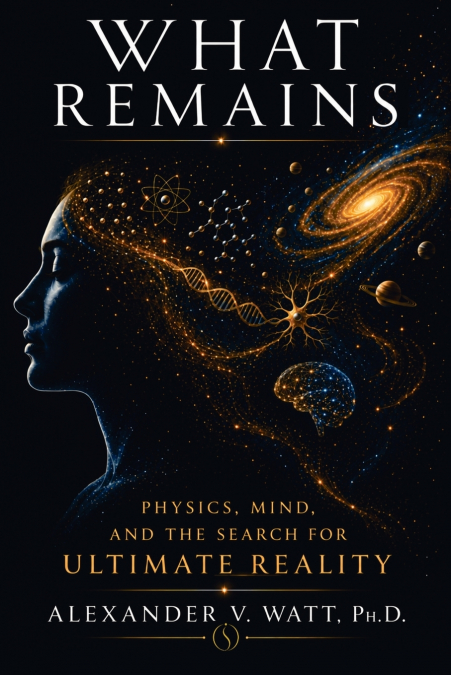
Every question begins with an assumption that usually remains unexamined.Who is the one asking?We investigate the universe, matter, life, the body, the brain, thought, memory, and consciousness. Throughout this search, one question remains in the background: Who is the one to whom all experience appears?What Remains: Physics, Mind, and the Search for Ultimate Reality follows a sustained investigation across physics, biology, neuroscience, psychology, philosophy, artificial intelligence, and Advaita Vedānta. Beginning with the physical universe, it proceeds through life, the body, the brain, empirical awareness, and the mind before reversing direction, turning from everything that can be known toward the one who knows.The inquiry begins with the world we seek to understand. Matter, living systems, the body, and the brain each offer a different point of entry. Thought and memory bring the investigation closer to the familiar sense of being someone: a person with a history, an identity, and a perspective on the world. Consciousness brings the question closer still. Every discovery and explanation appear in experience.This movement gives the book its central question. When attention turns toward the one who knows, what is being sought? Another object to observe? Another explanation to accept? Or an examination of the assumptions already present whenever we say, 'I know'?Scientific investigation and contemplative philosophy meet around this question. The book brings the study of the physical universe into conversation with the investigation of experience, drawing on fields that approach reality from different directions. Physics and biology address matter and life. Neuroscience, psychology, and artificial intelligence extend the inquiry into the brain, mind, and knowing. Advaita Vedānta brings the question of the knower into focus.For the reader, the starting point is immediate. A perception is known. A thought is known. Fear, memory, and the sense of identity are known. Even the question 'Who am I?' appears as something that can be examined. What happens when the investigation includes the identity of the investigator?What Remains invites the reader to stay with that question through the movement from the observable world toward the one to whom it appears. The search for ultimate reality becomes inseparable from an inquiry into knowing itself: what can be observed, what can be described, what can be conceived, and who is present in the claim to know.This book is for readers drawn to the meeting of science and philosophy, the study of consciousness, the possibilities of artificial intelligence, and the inquiry of Advaita Vedānta. It offers a place to examine questions that reach across these fields while remaining close to the experience from which every question begins.The reader is invited to bring these questions to both ordinary experience and intellectual investigation. What is the relationship between a remembered past and a present sense of self? When a thought changes, what makes that change known? Can the one who knows be approached in the same way as what is known?This book does not ask the reader to adopt another belief. It invites them to examine what every experience already reveals: every perception, thought, fear, memory, and sense of identity is known.When everything that can be observed, measured, described, or conceived has been examined, what remains?ABOUT THE AUTHORAlexander V. Watt, Ph.D., is a physicist, AI scientist, researcher, educator, and author. He has devoted much of his life to exploring questions across neuroscience, biology, philosophy, psychology, consciousness studies, and artificial intelligence. His writing brings scientific investigation into conversation with contemplative philosophy and Advaita Vedānta, examining both what can be known and the one to whom knowledge appears.