Joel Thomas
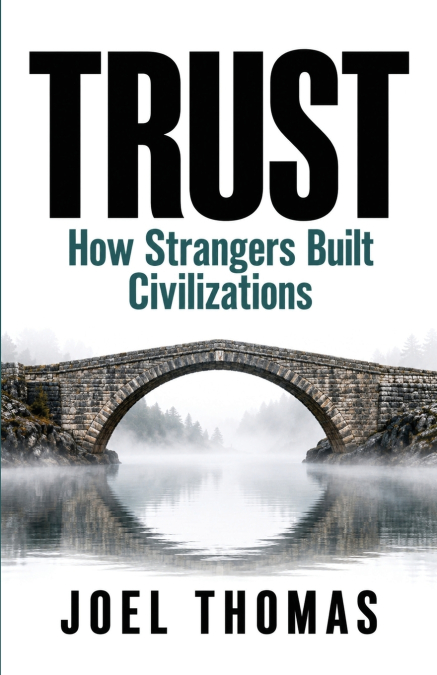
Trust is not a feeling. It is a wager.Most people think trust is warmth: faith, affection, the language of weddings and eulogies.They are wrong.That is the feeling, and it was built for a band of fifty faces. Trust is an exposure, voluntarily taken, on the future conduct of someone you cannot check. Civilization is billions of those exposures, renewed every day, between people who will never meet again.In Trust: How Strangers Built Civilizations, Joel Thomas examines trust not as virtue, sentiment, or naivety, but as infrastructure: the invisible, unpriced load-bearing wall of every society, noticed only when the crack appears.Across ten thousand years, strangers were made dealable by a procession of inventions as consequential as any machine. The oath and the god who witnessed it. The name that traveled by letter. The contract and the court behind it. The currency, the license, the badge, the brand, the star rating. Each manufactures confidence between parties who share nothing, and each must be trusted in turn.This book reveals the machinery, and what happens when it breaks.Inside, you will examine:• Why trust at civilizational scale is engineered reliance, not scaled-up affection• How kinship, gods, reputation, law, and money each pushed the circle of trust outward, and what each one cost• Why every trust system ends in someone who is simply believed, and why that is where it breaks• How trust is built slowly and destroyed instantly, and why distrust, once installed, protects itself from evidence• How the confidence man, the Ponzi scheme, and the institutional cover-up harvest the same machinery that builds trust• How a society replaces belief with surveillance and verification, and what that substitution quietly evicts• Why confidence in institutions has drained across the democracies, and who profits from the drain• How doubt became a manufactured product, and why synthetic media may be its most powerful instrument yet• Why trust is power’s cheapest fuel and distrust its cheapest weaponDrawing from history, economics, political theory, sociology, and psychology, Trust follows the structural patterns from the campfire to the platform to the deepfake.This is not a self-help book.It is not an argument that people should trust more, or less.It is not a lament for a lost golden age. The handshake world excluded as many people as it protected.It is a diagnostic framework for understanding how trust actually works.Trust is the fifth volume in the series that began with Power: How Influence, Authority, and Control Shaped Civilizations and continued with Fear, Control, and Risk. Power selects the bets. Fear misprices them. Control decides who may object. Risk keeps the ledger. Trust is what every one of them runs on.If you want to know why strangers can cooperate at all, why the most verified age in history is the least believing, why belief takes years to build and an afternoon to lose, and who collects when it is gone, this book shows you the schematic.