Mir M Hossain
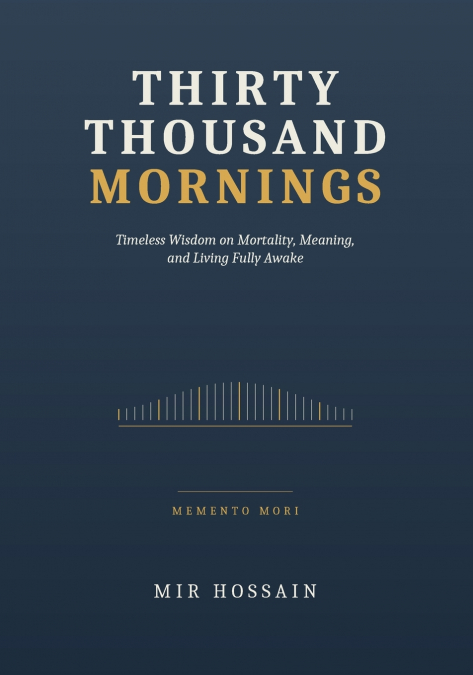
A person who lives to eighty-two gets a little under thirty thousand mornings. That is the whole allotment. Subtract the ones already spent. Subtract the ones lost to illness, to exhaustion, to grief. Subtract the mornings you will wake up angry about something you won’t remember a year from now. What’s left is not a countdown. It is an inventory - and almost nobody ever reads it.We are the first people in history who can go most of a lifetime without seeing anyone die. Death has been moved into buildings we don’t enter, handled by professionals we never meet, and described in language designed to avoid naming it. Passed away. Lost the battle. No longer with us. Meanwhile an industry worth tens of billions a year sells us the opposite story, and Silicon Valley says with a straight face that dying is a technical problem awaiting a fix.Every previous generation knew better, and built practices to keep the knowledge close.Seneca balanced the accounts of his life each evening, so that no reckoning could catch him unprepared. Marcus Aurelius wrote himself notes at dawn he never intended anyone to read. Epictetus, born a slave, taught his students to name aloud what each thing actually was - a cup is a cup, and cups break - so that loss would not arrive as betrayal. Buddhist monks were sent to the charnel grounds to sit with bodies at every stage of coming apart. Renaissance painters set a skull on the table beside the lute and the half-peeled lemon. Medieval Europe produced an entire literature on the art of dying well and expected ordinary people to study it.None of this was morbid. All of it pointed the same direction: wake up, while there is still time to wake up in.Thirty Thousand Mornings gathers what those traditions understood and puts it to work on a modern life - the one with the phone in it, the deferred conversation, the trip to see aging parents that can always happen someday.The book makes a single sustained argument: finitude is not life’s opponent but the thing that makes anything matter at all. An immortal being would have no reason to do anything on a Tuesday rather than a Tuesday four centuries from now. It is the limit that confers weight.From there it works outward. Why we fear dying more than being dead, and what the psychology of denial actually costs us. How mortality awareness sharpens attention and returns hours that distraction had quietly taken. What death reveals about love - why grief is not the opposite of love but its continuation. Why the dying so rarely regret the things they did. What a good death asks of us, practically and emotionally, long before it arrives. And what the major traditions say about whatever comes after, including the honest answer that we do not know.It ends with thirteen daily practices. Each names how long it takes and when to do it. None requires belief in anything. Most take under five minutes. They are meant to be started this morning, not admired from a distance.This is not a book about dying. It is a book about the quality of attention available to people who have stopped pretending they have unlimited time - written for anyone who has caught themselves postponing their own life and wants to know what the alternative looks like in practice.The question was never how much time you have. The question is what you are doing with the hour you are standing in.