Joseph Habimana Ngoma / Joseph Ngoma
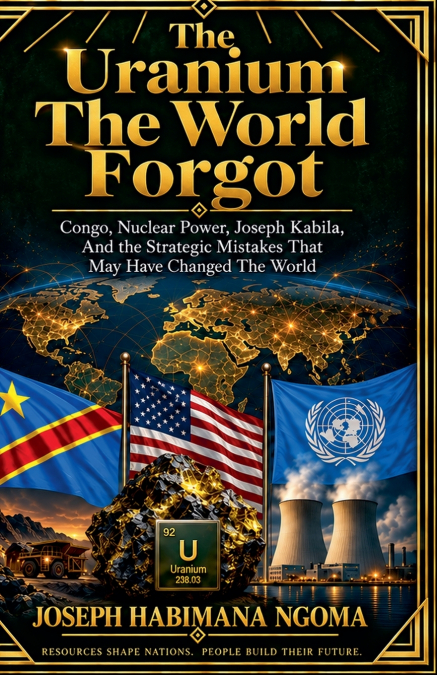
What if one of the greatest strategic mistakes of the modern era was not simply the world’s failure to stop the wars in the Democratic Republic of Congo-but its failure to understand what could happen when some of the planet’s most strategically important resources remained vulnerable to conflict, corruption, foreign competition, smuggling, and weak international oversight? The Uranium the World Forgot: Congo, Nuclear Power, Joseph Kabila, and the Strategic Mistakes That May Have Changed the World is a provocative investigation into the hidden relationship between Congo’s extraordinary mineral wealth and the forces that have shaped global power. From the legendary uranium of Shinkolobwe that became connected to America’s Manhattan Project to today’s global competition for cobalt, copper, coltan, lithium, and other critical minerals, Joseph Habimana Ngoma asks a disturbing question: Has the world repeatedly benefited from Congo’s strategic wealth while failing to protect the country whose soil produced it?The book travels through colonial exploitation, the Cold War, the fall of Mobutu, the Congo wars, the rise and long presidency of Joseph Kabila, regional intervention, foreign mining interests, and the complex international networks through which Congolese resources entered global markets. At the center of the investigation is an even more urgent issue: uranium.What happens when uranium-bearing material moves through complex mineral supply chains? How effective are international safeguards? Can the world fully account for strategically sensitive material originating in unstable or poorly monitored environments? And what could the consequences be if governments discover vulnerabilities only after dangerous materials have already crossed borders? Rather than presenting speculation as fact, The Uranium the World Forgot separates documented history from allegations, scientific evidence from political claims, and established facts from questions that still demand investigation. It challenges governments, researchers, international institutions, corporations, and African leaders to follow the evidence wherever it leads.The book also confronts America’s relationship with Congo and asks whether Western governments sometimes prioritized short-term political stability while underestimating the long-term importance of Congolese sovereignty, institutions, mineral security, and strategic independence, but this is not simply a book about America, it is about Congo, it is about Africa.It is about China, Europe, neighboring states, multinational corporations, global supply chains, nuclear security, technological competition, and a world increasingly dependent upon minerals concentrated beneath African soil. Above all, it presents a powerful principle: Congo must control Congo.The future cannot be another century in which Congolese resources build prosperity elsewhere while Congolese communities remain surrounded by poverty, insecurity, and conflict. Congo must strengthen its institutions, protect its strategic mines, trace its mineral supply chains, expand domestic processing and manufacturing, and transform underground wealth into education, infrastructure, technology, security, and opportunity for its people. Yesterday, the world needed Congo’s uranium, today, it needs Congo’s cobalt and copper. Tomorrow, it may depend upon resources whose strategic importance humanity has not yet fully understood.The Uranium the World Forgot is therefore more than a journey into the past. It is a warning about the future, because the greatest question may not be what lies beneath Congo. The greatest question is who will control it, and what the world will become because of it.