Naim Tahir Baig
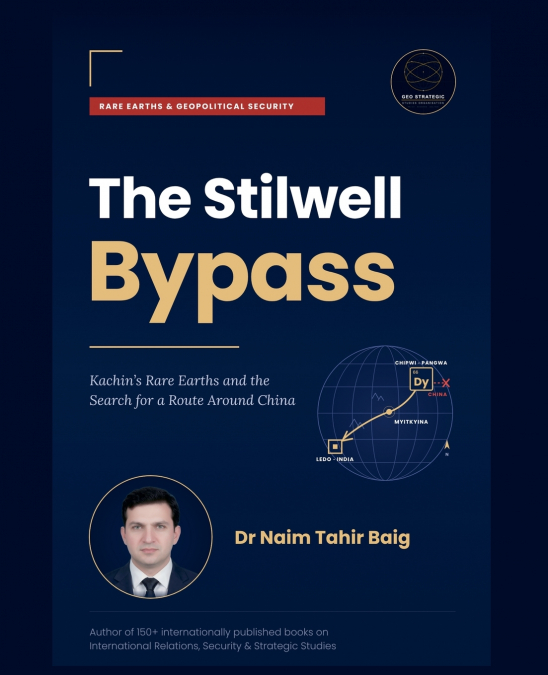
In 1942 the United States Army pushed a road out of Ledo, in Assam, toward China. More than eighty years later, a question hangs over the same ground: could a different cargo travel part of that route, heavy rare earths dug from the clay hills of Kachin State in northern Myanmar and carried not east into China, as they are now, but west, toward India and toward separation plants that stand outside Chinese control?The cargo matters because of what two of its elements do. Dysprosium and terbium keep a neodymium magnet strong when it runs hot, which is why they sit inside the motors of electric vehicles and the generators of wind turbines. China holds nearly 90 percent of the world’s rare-earth processing capacity, and since about 2021 a large share of the feed for its separation plants has come from the ionic-clay hills around Chipwi and Pangwa. Since October 2024 that mining belt has been held by the Kachin Independence Army, an armed organization at war with Myanmar’s military government, while the border gates through which the ore leaves are held by Beijing. Governments in Delhi and Washington, and companies from Kuantan to Louisiana, have begun to ask what it would take to buy that ore, or the metal made from it, some other way.The Stilwell Bypass takes the word 'bypass' seriously enough to test it. In eighteen chapters, the book follows the ore from the clay hills to the separation plants, follows the road from Kilometer Zero at Ledo across Pangsau Pass and the Hukawng Valley to Myitkyina, and listens to the people who hold the ground and to the residents downstream who live with the water, the fields and the price. It examines Beijing’s control of the gates, the competing claims of Myanmar’s junta and its opponents, India’s request for a sample of ore with no commercial heavy-separation plant to receive it, and Washington’s dated deadlines and untested body of law. A Brazilian ionic-clay mine serves as an analogue for how long a bypass takes, and cases from Congo, Afghanistan and Indonesia put the argument to the test.The verdict is precise. A bypass works only if three conditions hold at once: an authority able to deliver and protect the ore, a plant able to separate it into oxides outside China, and a buyer able to pay for it lawfully. On the public record as it stood in the middle of October 2026, none of the three yet holds for Kachin feed. The sequence that follows is plant, paper, road, with the road last because it is useless alone. The bypass is worth having as a hedge and a bargaining chip long before it is worth anything as a supply line.Built entirely from the public record, including company filings, legislation, customs and trade data, wire-service and trade-press reporting, Burmese, Kachin and Indian news outlets, human-rights and environmental research, and the scholarship on Kachin history and the Ledo Road, the book offers policymakers, analysts, investors and students of international relations, Myanmar, India and critical minerals a clear framework for judging every future claim about a route around China.