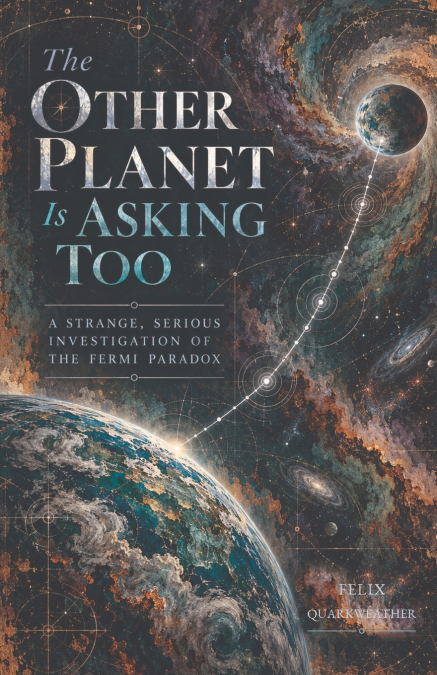
Felix Quarkweather
What if the universe is full of life-and every civilization thinks it is alone?On Earth, we keep asking why nobody has answered us. On Erum, a world that exists only in this book, astronomer Seli puts the same question to an artificial intelligence named Moth. Moth can analyze observations, propose explanations, and infuriate its operator with precision. What it cannot do is introduce Seli to another sky.Together they investigate the Fermi paradox: in a cosmos so old and seemingly rich in potential homes for life, why have we found no confirmed extraterrestrial civilization? Their suspects range from hidden oceans and unfamiliar genetics to the Drake equation, the Great Filter, vanished radio signals, and civilizations separated by millions of years. Then they confront an even harder question: if intelligent beings could have spread between the stars, where is the enduring evidence?Their most intriguing suspect is the Two-Sky Hypothesis. What if the problem is not only distance, but timing, technology, and the assumptions built into our searches? Rather than announcing that they have solved the mystery, Seli and Moth put the idea on trial. They examine its weaknesses, compare rival explanations, and ask what a real observation would need to show.Part cosmic detective story, part accessible popular science, this strange and sharply funny book explores astrobiology, the search for extraterrestrial intelligence, and the discipline of admitting what we do not yet know. It is for curious readers who love the universe enough to question their favorite answers.The silence of the sky tells us something about our evidence. What it means is still an open question.