Bafana Martin
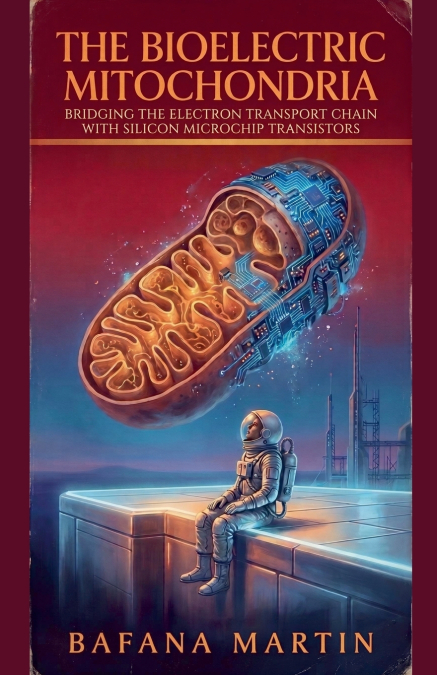
What if the human body could run without oxygen?For two billion years, the electron transport chain has been the engine of complex life. Embedded in our mitochondria, this biological nanomachine converts the food we eat and the air we breathe into usable energy. It is elegant, ancient, and inextricably bound to oxygen. When it fails, the result is catastrophic: energy starvation, cellular poisoning, and a cascade of devastating diseases.But what if we didn’t have to rely on it? What if the electron transport chain could be replaced?The Bioelectric Mitochondria is a rigorous, boundary-pushing scientific monograph that explores the audacious engineering concept of replacing the biological electron transport chain with a silicon microchip. Blending biochemistry, semiconductor physics, and evolutionary theory, Bafana Martin charts a logical pathway from the known to the unbuilt.Inside, you will discover:The Biological Engine: A detailed, accessible breakdown of the ETC, its chemiosmotic mechanics, and the pathophysiology of mitochondrial diseases.The Silicon Analogue: How MOSFET transistors move electrons, how bioprotonic devices bridge the gap between electronics and biology, and how Boolean logic can map directly onto biological proton pumps.The Oxygen Bypass: The central mechanic of the book-how a nanoscale capacitor or reversible redox couple can serve as an electrical terminal acceptor, eliminating the need for molecular oxygen.The Solid-State Individual: What happens to the human body when it no longer needs to breathe. The atrophy of the lungs, the shift in cardiovascular function, the eradication of oxidative stress, and the thermodynamic efficiency of a programmable metabolism.The Evolutionary Divergence: The philosophical and ethical implications of germline modification, the emergence of the 'Silicon Clade,' and what it means for a new kingdom of life to split from the biological tree.This is not science fiction. It is disciplined speculation. Martin does not flinch from the disadvantages-the fibrosis, the silica waste, the loss of apoptotic regulation, the terror of abrupt system failure. He explores the iterative engineering solutions that might overcome these barriers, and ultimately asks the most important question of all: Just because we can replace the engine of life, does it mean we should?For readers of The Vital Question and fans of hard science fiction, The Bioelectric Mitochondria is a journey to the very edge of what it means to be human.