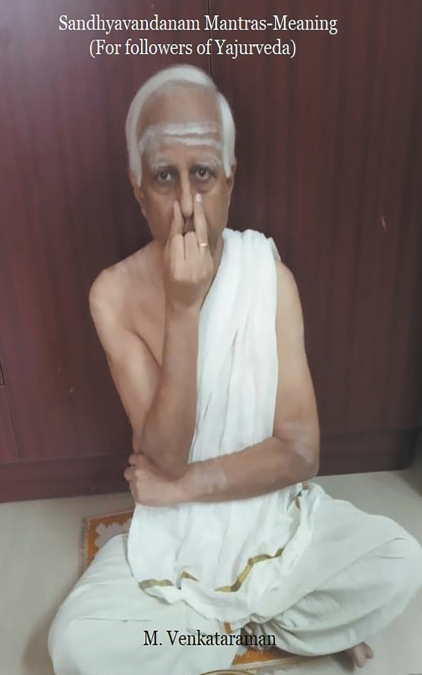
Sandhyavandhanam Mantras-Meaning (For followers of Yajurveda)

Sandhyavandhanam Mantras-Meaning (For followers of Yajurveda)

M VENKATARAMAN

9,31 €
IVA incluido
Consulta disponibilidad
Editorial:
M. Venkataraman
Año de edición:
2021
ISBN:
9798201565480
Añadir a favoritos

Sandhya Vandanam is one of the efficient spiritual rituals of the Hindus. It helps in the realisation of the Divinity of the Self called as Atman in Hindu philosophy. It is an obligatory daily ritual called as Nithya Karma. It is an all-round complete ritual which incorporates the principles of the Supreme Divinity referred to as Brahman. Each part of the ritual gives an external expression for the development of an internal mental attitude and spiritual feeling. In this process, there is an effort to bring about self-purification and attunement to the Cosmic Reality.The rituals are to be done thrice daily-early morning, at noon and at sunset. In the Hindu way of life, each person is primarily affiliated to a particular Vedic study, namely the Rig Veda, the Yajur Veda and the Sama Veda. Though the objectives are generally the same, there are variations in the mantras of these three vedas.This book is an attempt to give the meanings of some of the important Mantras of the Yajur Veda sect basically followed in the southern part of India. Based on the different stages of the ritual, it has been divided into eighteen chapters for the purpose of easy grasp and understanding by those who are not well-versed in the knowledge of these mantras.An audio book has also been published and is available with audio booksellers.

Artículos relacionados

Otros libros del autor

  • A Brief Annotation on the Immortality Ode and a few other poems of William Wordsworth
    M VENKATARAMAN
    William Wordsworth is one of the greatest poets of English literature. He is remembered as a poet who was concerned with the relationship of human beings to nature. He strongly believed in using the vocabulary and speech patterns of common people in his poems. According to him, human beings who grow up in the lap of Nature are perfect in every respect. Love for nature and sympa...
  • A Brief Summary of ’Atmaarpana Stuthi’ or ’Unmattha Panchaa Shath’ of Appayya Dikshitar
    M VENKATARAMAN
    The Atmaarpana Stuthi is a hymn in Sanskrit language composed by Appayya Dikshitar, one of the great saints and proponent of Advaita Philosophy after Adi Sankara. It is a hymn in praise of Lord Shiva and is also known as ’Unmattha Panchaa Shath’.Once Dikshitar felt that he has to put himself to a test as to whether his devotion to Lord Shiva was indeed true. He thought, ’Suppos...
  • An Introduction to Intellectual Property Rights
    M VENKATARAMAN
    Intellectual Property is a subject of recent origin. We own houses, jewels, shares, money in the form of cash etc. These are the things we know as ’Properties’. These are tangible assets. We enjoy them as we own them. Unless and until we offer them to somebody else, these things which we own cannot be taken away and enjoyed by others. ’Intellectual Property’, on the other hand,...
  • The Bhagawat Gita (With a brief summary in English)
    M VENKATARAMAN
    The Bhagawat Gita is one of the main religious literature in the Hindu way of life. It contains about seven hundred verses in Sanskrit language and is divided into eighteen cantos. It is the essence of the philosophy contained in the Upanishads and is a part of the Mahabharata which describes the story of the Pandavas and the Kouravas. The development of the various incidents i...
  • Slokas of Sri Ramodantam
    M VENKATARAMAN
    Valmiki Ramayana, as we all know, consists of 24000 verses written in Sanskrit by Sage Valmiki. There are other works on the life and deeds of Sri Rama in other languages like the Kamba Ramayanam in Tamil and the Ramacharitamanas of Goswamy Tulsidas in Awadhi.In the 15th century, one Parameshwara Kavi has composed in just about 200 verses in Sanskrit, the seven chapters of the ...
  • A Brief Annotation of Thomas Gray’s ’Elegy Written in a Country Churchyard’ and John Keat’s ’Ode to a Nightingale’
    M VENKATARAMAN
    In this book, a brief annotation has been given on two of the famous poems of English literature. They are the 'Elegy Written in a Country Churchyard' of Thomas Gray and the 'Ode to a Nightingale' of John Keats. The themes of human mortality and the passage of time are central to both these poems.An elegy is generally a reflective poem. It laments the loss of someone or somethi...