Khosro Hekmat
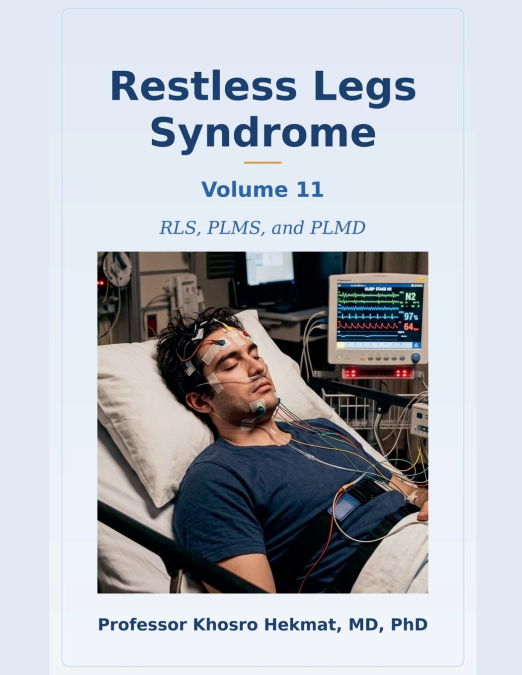
The legs that carry on through the night. A number appears on the sleep study report: the PLM index. One in three middle-aged adults is above the usual threshold, and six in ten older men. And hardly anyone explains what it means. This volume separates three things that are constantly confused: restless legs syndrome as a disease, periodic limb movements as a measurement, and periodic limb movement disorder as a diagnosis of exclusion. Only that separation makes your own report readable. It handles the open questions without glossing over them: what the movements mean for heart and circulation, why a single night of recording says almost nothing, and why a normalised index is not yet a treatment success. The 2025 change in treatment guidance and what is left of the PLMD diagnosis after it are here too. WHAT IS IN THE BOOK- What actually happens during the night- Where the movements come from: iron, dopamine, genes, spinal cord- The disputed question: do these movements do any harm at all?- Heart and circulation, the most serious open point- What is measured in the sleep laboratory and what appears on the report- Why a single night is not enough- When treatment is indicated and when explicitly not- Children and adolescents, and what you can do yourself WHO THIS BOOK IS FORFor everyone holding a sleep study report with a PLM index on it, for patients whose partner notices the movements at night, and for health professionals looking for the current state of knowledge on PLMS and PLMD. ABOUT THE SERIESVolume 11 of 52 in the book series on restless legs syndrome, part 'Forms of the Condition and Differential Diagnosis'. Every volume can be read on its own. The statements in this volume rest on 166 professional sources, each one listed individually in the reference section.