Jiazheng Chen
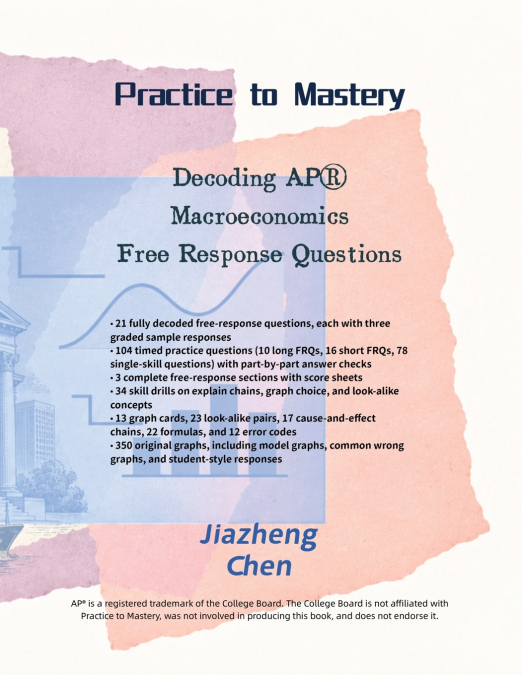
Most students who lose points on the AP® Macroeconomics free-response section already know the economics. They lose points to an unlabeled axis, a curve shifted the wrong way, a chain of reasoning that skips a link, or a correct number with no work shown. Practice to Mastery: Decoding AP® Macroeconomics Free Response Questions shows you exactly how each point is earned, then makes you practice until earning it is automatic.ORGANIZED BY HOW POINTS ARE SCOREDInstead of reteaching the course unit by unit, the book trains the skills that readers actually score. Part 0 decodes the rubric, the task verbs (identify, explain, calculate, draw a correctly labeled graph) and the twelve errors that cost students the most points. Each error has a code, E1 through E12, used throughout the book, so you can tally your own misses and see exactly what to fix.THE THREE KINDS OF POINTS, ONE AT A TIMEGraph points: every core graph with its required labels, the two-point structure of a graph question, and the most common wrong drawings, marked and corrected.Calculation points: a four-step write-up (formula, substitution, result, units and direction) and fifteen formula cards covering unemployment, GDP and price indexes, multipliers, money creation and T-accounts, real interest rates, the quantity theory of money, the balance of payments, exchange rates and opportunity cost.Explanation points: nine cause-and-effect chains that readers score link by link, with sentence frames that turn an assertion into a full explanation.A FULL CHAPTER ON THE RESERVE MARKETMonetary policy implementation is the hardest graph on the current exam, so it gets its own chapter. You learn the ample-reserves framework the course now uses: administered rates, interest on reserves, the floor of the reserve demand curve, and both accepted ways to draw a policy change. Most of the chapter’s practice uses ample reserves, and a supplement covers open-market operations, the money multiplier and the money market under limited reserves.LEARN, PRACTICE, CHECKEvery skill chapter follows the same cycle. In Learn, decoded examples show a full-credit, a partial-credit and a low-credit response, with a point-by-point table that names the reason and the error code for each lost point. In Practice, you answer original questions yourself, in timed conditions, with answer space and graph boxes. In Check, you score yourself with the rubric, model graphs, a common wrong graph, several acceptable answers, the common misses and a Score Yourself checklist with one box per point. Five of the long questions also include a decoded mid-range response that shows where a typical answer leaks points.A TOOLKIT FOR THE LAST WEEKSThe Graph Library: thirteen compact graph cards with must-label lists, common changes and the wrong drawings to avoid.Look-Alike Pairs: twenty-three pairs of ideas students confuse, such as deficit and debt, or a movement along and a shift of the Phillips curve.The Explain Ladder: four rungs from a bare direction to a full chain tied to the prompt.One Shock, Every Graph: three shocks, each followed through AD-AS, the Phillips curve, the financial markets, the foreign exchange market and the balance of payments.WHAT YOU WILL FIND INSIDE21 fully decoded example questions123 original practice questions worth 602 pointsThree complete timed free-response sections with score sheetsAn appendix with all seventeen chains, twenty-two formulas, task verbs, error codes and a graph-labeling checklistAP® and Advanced Placement® are registered trademarks of the College Board, which was not involved in the production of, and does not endorse, this product.