Inicio > Humanidades > Filosofía > Ética y filosofía moral > Power, Politics, and Personality
Power, Politics, and Personality

Power, Politics, and Personality

Nicholas Emler

23,95 €
IVA incluido
Disponible
Editorial:
Hogan Press
Año de edición:
2026
Materia
Ética y filosofía moral
ISBN:
9798995161295
23,95 €
IVA incluido
Disponible
Añadir a favoritos

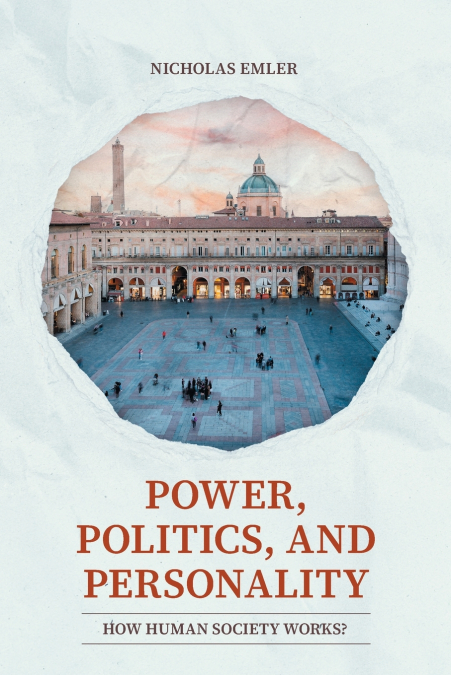
In Power, Politics, and Personality, Emler offers a completely new and original perspective on how humans function in, and as, societies. This book has the scope and vision of the masterworks of the social sciences. It is persuasive, profound and deeply thought-provoking. A must read for economists, psychologists, biologists, historians and anthropologists, and a delightfully engaging one for anyone curious to understand both the wonders and terrors of our collective human existence.- Dominic Abrams, Professor of Social Psychology, University of KentNick Emler is the most important social psychologist of his generation and this book is proof. Based on 50 years of close reading and careful thinking, he synthesizes a vast literature to answer big questions ('what is intelligence?') and set forth a general theory of social action as described by Talcott Parsons 70 years ago. Original, thought-provoking, and true.- Robert Hogan, Founder and President, Hogan Assessment SystemsHow do societies sustain a moral consensus, and often do so while containing vast disparities in wealth? How does that moral consensus change? Who gets to govern these societies, to control the levers of political power, and with what consequences? And what determines the degree to which the rest of us participate in the choice of our political leaders? Finally, what part do our conversations play in these matters? These are the questions addressed in this book.


Artículos relacionados

  • Ka Ab Ba Building The Lighted Temple
    Dr Terri R. Nelson / Dr Terri RNelson
    The book KaAbBa Building The Lighted Temple/Metaphysical Keys to the Tree of Life draws a circle that is inclusive of the Afrikan origin of the Ancient Kemetic/Egyptian wisdom. It reveals the undeniable root and link of Ancient Africa to all the religious systems that would develop worldwide. This book is explosive in its power to convey the meaning of KaAbBa, the Medu Neter  (...
    Disponible

    37,41 €

  • Technoethics and the Evolving Knowledge Society
    Rocci Luppicini
    Recently, there has been a major push to rediscover the ethical dimension of technology across the sciences, social sciences, and humanities. Technoethics and the Evolving Knowledge Society: Ethical Issues in Technological Design, Research, Development, and Innovation examines human processes and practices connected to technology embedded within social, political, and moral sph...
  • Kant
    Immanuel Kant
    Kant’s Groundwork of the Metaphysics of Morals is one of the most important works in modern moral philosophy. It belongs beside Plato, Aristotle, Machiavelli, and Hobbes. Here Kant sets out to articulate and defend the Categorical Imperative - the fundamental principle that underlies moral reasoning - and to lay the foundation for a comprehensive account of justice and human vi...
  • On the Duty of Civil Disobedience
    HENRY DAVID THOREAU
    Civil Disobedience argues that citizens should not permit their governments to overrule their consciences, and that they have a duty to avoid allowing their acquiescence to enable the government to make them the agents of injustice. Thoreau was motivated in part by his disgust with slavery and the Mexican-American War, but the sentiments he expresses here are just as pertinent ...
  • Beyond Good and Evil
    Friedrich Nietzsche
    Nietzsche, though primarily a philosopher, wrote widely on art, philology, history, religion, tragedy, culture, and science.  In 1886, at the height of his powers, he published Beyond Good and Evil.  Here he examines much of the best of human thought--dogmatic philosophy, Judeo-Christian morality, science and democracy – and finds it lacking.  Rejecting “slave-morality” he pres...
  • Beyond Good and Evil
    Friedrich Nietzsche
    Nietzsche, though primarily a philosopher, wrote widely on art, philology, history, religion, tragedy, culture, and science.  In 1886, at the height of his powers, he published Beyond Good and Evil.  Here he examines much of the best of human thought--dogmatic philosophy, Judeo-Christian morality, science and democracy – and finds it lacking.  Rejecting “slave-morality” he pres...
    Disponible

    9,99 €