Michael H. Glantz / Michael HGlantz
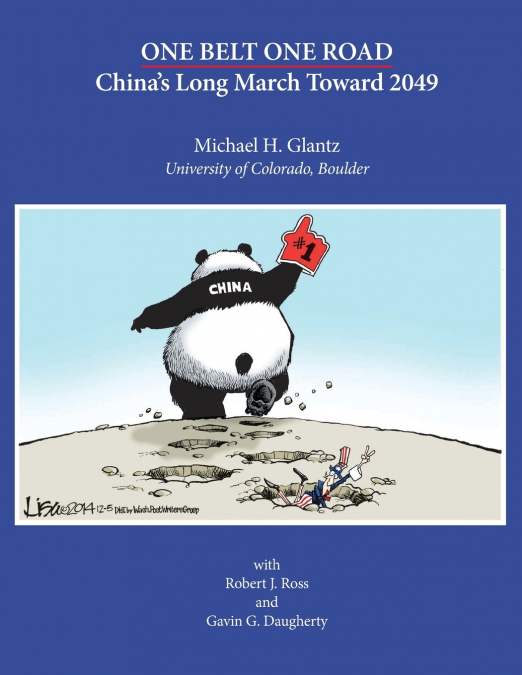
This book provides a brief overview of China’s “One Belt One Road” Initiative (OBOR), now officially re-labeled the BRI (Belt and Road Initiative). Looking back from the vantage point of 2019 to 2013, when OBOR was first announced as China’s new international infrastructure and trade initiative, OBOR/BRI has proven to be nothing less than an eye-catching program to assist developing countries in need of financing for sorely-needed infrastructure to achieve their economic development goals.Today, more than 70 countries and organizations are involved in the OBOR/BRI enterprise. Each one of these appears to have its own interesting story to tell related to China’s support for its infrastructure projects including but not limited to pipelines, high-speed and other rail lines, communications networks, roads, deep-water and air ports, energy grids and inland transport and cargo hubs. China supplies developing countries with the access to loans, construction materials and workers. OBOR/BRI is sold by China as a win-win(-win) situation in which China and the loan recipient benefit economically (with the third win representing peace).The already rapid growth rate of China’s OBOR received an unanticipated major boost when Donald Trump was elected US President in November 2016 and took office in mid-January 2017. Trump’s campaign rhetoric and ensuing policies exposed his support for American isolationism as reflected in his campaign slogan “America First.” Since his inauguration, the US has aggressively, intentionally, and incrementally embarked on abandoning its global leadership position and commitments, which it had held since the end of WWII. China through its OBOR has since taken advantage of the geopolitical vacuum created by America’s self-imposed abdication not only from its global leadership status but from long-standing regional alliances and trade agreements as well.Although each region, country or project mentioned in this book merits its own book-length, in-depth attention, here we highlight OBOR’s geographic and functional stealth-like expansion around the globe on land, sea and in space. An extensive reference list is provided to enable readers to pursue various OBOR/BRI-related topics of interest.The potential biases of various observers notwithstanding, there are challenging issues raised about the long-term sustainability of the OBOR/BRI. As the OBOR/BRI matures, questions about its economic viability are increasingly being raised. The issues raised by these questions and concerns should identify lessons that need to be learned both by China (governments, banks and companies) and by prospective OBOR/BRI partners. Fears of debt-trap diplomacy are but one example.Most recently, articles are appearing that question whether such an ambitious global infrastructure development initiative is really viable in the long run. While China can control its actions and what it chooses to invest in to meet a wide range of its objectives, there are intervening factors over which it has little to no control. China’s ability to provide loans to developing economies can be reduced by happenings in the global economy, whether a trade war with the US, a downturn in its economy, or an economic inability of people around the globe to buy its goods and services.One Belt One Road: China's Long March to 2049 is the first book to explore both the scope and detail of this transformation of the global balance of power, as seen through the lens of OBOR/BRI.