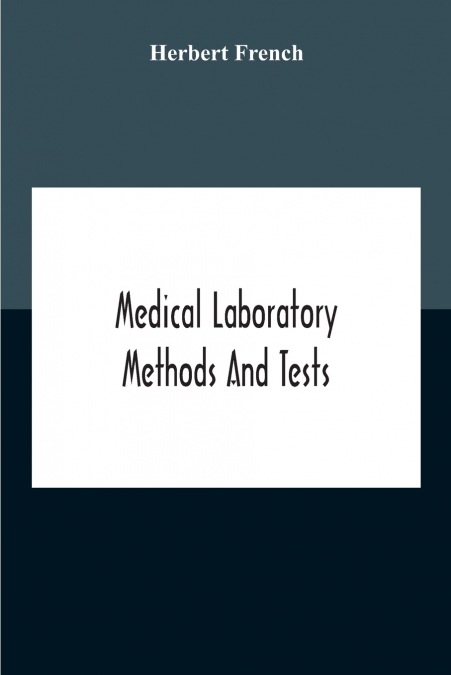
Herbert French
Medical Laboratory Methods And Tests offers clear, hands-on instruction from an earlier era of clinical care. Clear methods for precise diagnosis. Written as a clinical lab manual, Herbert French’s practical guide brings together reliable medical laboratory techniques and laboratory diagnostic methods used at the bench: stepwise blood test procedures, a concise urine analysis guide, and foundational microbiology laboratory tests are described with an emphasis on observation, hygiene and reproducible results. Its measured, pragmatic tone trains disciplined observation, specimen handling and basic microscopy skills without rhetorical flourish. Far from abstruse theory, the work privileges procedure, calm judgement and repeatability, making it both a dependable student laboratory reference and a functional medical technician handbook. Readers seeking essential lab procedures will find method and reasoning combined with a sense of craft that still informs modern practice.Valuable as a record of early 20th century medicine and historical laboratory practices, the book illuminates the craft behind diagnosis before automation, when judgement, manual technique and simple apparatus mattered. The text gives casual readers a precise portrait of clinical routine; for practitioners it serves as a primer in laboratory thinking, and for collectors the volume is a welcome addition to any laboratory science collection. Republished by Alpha Editions in a careful modern edition, this volume preserves the spirit of the original while making it effortless to enjoy today - a heritage title prepared for readers and collectors alike. Whether you are a curious reader, a trainee on the laboratory floor, a historian of medicine, or a collector of classic medical literature, this edition reconnects practical skill to historical perspective with quiet authority.Useful in teaching and display alike, the volume functions as a practical classroom companion and a compact reference on foundational laboratory diagnostic methods. Students and trainees find procedural clarity; practising technicians will recognise familiar logic; historians and antiquarian collectors will appreciate the direct evidence of historical laboratory practices. The language is brisk, the instructions unadorned, and the overall effect is of a working document that still speaks to the needs of laboratory science and to those who collect its story.