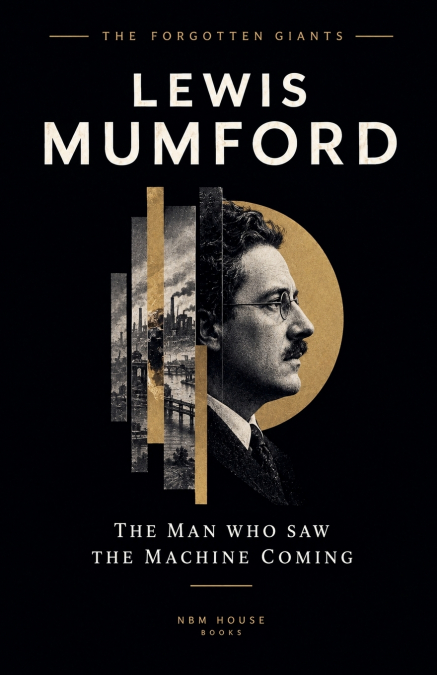
Len Biel
Lewis Mumford saw the machine coming long before the rest of us.He died in 1990, never having used a smartphone, a search engine, or a social-media feed. Yet his analysis of technological civilization-its organizational logic, its power, its psychological and ecological costs-reads as if written for the age of data centers, algorithmic management, platform monopolies, and artificial intelligence.In Lewis Mumford: The Man Who Saw the Machine Coming, Len Biel offers a vivid intellectual biography that treats Mumford’s life and work as a continuous effort to understand the 'megamachine': the vast apparatus, older than the steam engine and more pervasive than any single device, that organizes human beings as standardized components of larger technical systems. From the labor gangs that built the pyramids to the factories of the industrial age, from the highway systems and nuclear arsenals of the mid-twentieth century to the invisible infrastructures of today’s computational world, Mumford traced a single, unfolding pattern.Biel follows that pattern across Mumford’s major works and shows why it remains indispensable. The book explores the distinction between authoritarian and democratic technics, the city as both machine and living organism, the rise of clock time and quantified human value, the psychological formation of the 'man-machine,' and the ecological reckoning Mumford demanded decades before it became conventional wisdom. It also tests Mumford’s insights against the present: Silicon Valley’s platform order, the cognitive reach of artificial intelligence, the prospect of partially autonomous technical systems, and the question of what kind of cities-and what kind of human beings-these systems are producing.Clear-eyed about Mumford’s blind spots as well as his breakthroughs, this is both a portrait of a major twentieth-century thinker and a sharp diagnostic tool for the technological order we now inhabit. The machine is bigger than the machine. Mumford spent a lifetime making that fact visible. The choice of what to do with the visibility remains ours.