Legal Aspects of Privatisation

Legal Aspects of Privatisation

Legal Aspects of Privatisation

Bulent Seven

50,09 €
IVA incluido
Disponible
Editorial:
Universal-Publishers.com
Año de edición:
2002
Materia
Economía política
ISBN:
9781581121742
50,09 €
IVA incluido
Disponible
Añadir a favoritos

To present a comprehensive analysis of the concept of privatisation its origins and limits, (b) To identify the legal and institutional framework for privatisation in different European countries from a comparative perspective; (c) To define and analyse particularly legal issues which arise during the privatisation transactions: e.g. labour law, competition law etc.; (d) To evaluate which features of the successful legal and organisational framework of privatisation have been successful so as to provide guidelines for those individuals and organisations participating in the privatisation exercises.This work found out that there is no simple, internationally applicable recipe for privatisation; various legal methods and techniques can be used to privatise state owned enterprises. Because each country has different circumstances, it is impossible to provide a unique model for privatisation; each country needs to design its own model according to its circumstances.Privatisation is an essential but insufficient element for structural economic reform in the economy and society. Privatisation is not a panacea, it is not the solution to every economic and administrative problem; selling an enterprise to the private sector does not mean an end to all problems. Also privatisation is not an overnight process or a magic touch; it will be a lengthy process. Furthermore, a decision that something can be privatised does not mean that it should be privatised.In that context, privatisation is not good or bad; it is an economic and social instrument. If it is well designed it may bring substantial benefits to the economy and society.In many countries, many state owned enterprises, particularly the ones which are financially weak, have still not been privatised. This finding revealed that the privatisation process will be in the political and economic agenda for at least few more decades.


Artículos relacionados

  • Private Affluence and Public Squalor
    Paul L L Nevins / Paul L Nevins
    Are the values that Americans collectively hold destroying the American Dream? The answer to that question depends upon the answers to some very specific questions. What do we as citizens of the United States believe we owe to one another as citizens? What is the purpose of government? What is of the role of the private enterprise? What is the meaning of equal opportunity? To w...
    Disponible

    24,04 €

  • Of Privacy and Power
    Abraham L. Newman / Henry Farrell
    How disputes over privacy and security have shaped the relationship between the European Union and the United States and what this means for the futureWe live in an interconnected world, where security problems like terrorism are spilling across borders, and globalized data networks and e-commerce platforms are reshaping the world economy. This means that states’ jurisdictions ...
    Disponible

    30,80 €

  • Migration and Democracy
    Abel Escribà-Folch / Covadonga Meseguer / Joseph Wright
    How remittances-money sent by workers back to their home countries-support democratic expansionIn the growing body of work on democracy, little attention has been paid to its links with migration. Migration and Democracy focuses on the effects of worker remittances-money sent by migrants back to their home countries-and how these resources shape political action in the Global S...
    Disponible

    142,65 €

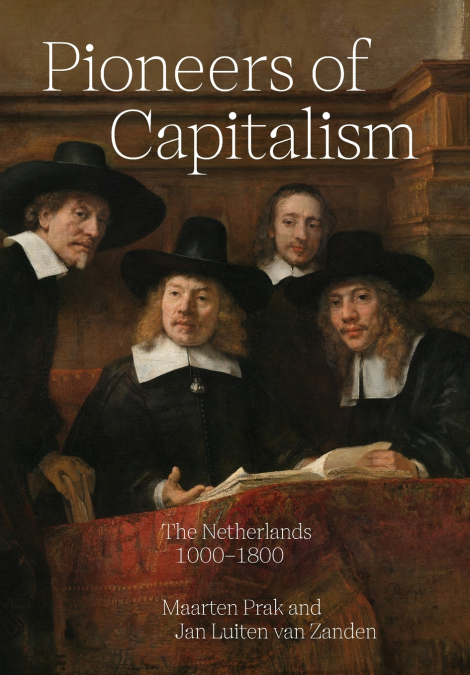
  • Pioneers of Capitalism
    Jan Luiten van Zanden / Maarten Prak / Ian Cressie
    How medieval Dutch society laid the foundations for modern capitalismThe Netherlands was one of the pioneers of capitalism in the Middle Ages, giving rise to the spectacular Dutch Golden Age while ushering in an era of unprecedented, long-term economic growth. Pioneers of Capitalism examines the formal and informal institutions in the Netherlands that made this economic miracle...
    Disponible

    50,45 €

  • Pillars of Prosperity
    Timothy Besley / Torsten Persson
    How nations can promote peace, prosperity, and stability through cohesive political institutions'Little else is required to carry a state to the highest degree of opulence from the lowest barbarism, but peace, easy taxes, and a tolerable administration of justice; all the rest being brought about by the natural course of things.' So wrote Adam Smith a quarter of a millennium ag...
    Disponible

    57,93 €

  • Luxury Fever
    Robert H. Frank
    The turn of the twenty-first century witnessed a spectacular rise in gross consumption. With the super-rich setting the pace, everyone spent furiously in a desperate attempt to keep up. As cars and houses grew larger and more expensive, the costs were enormous--not only monetarily but also socially. Consumers spent more time at work and less time with their family and friends; ...
    Disponible

    35,97 €