Henri Welschinger
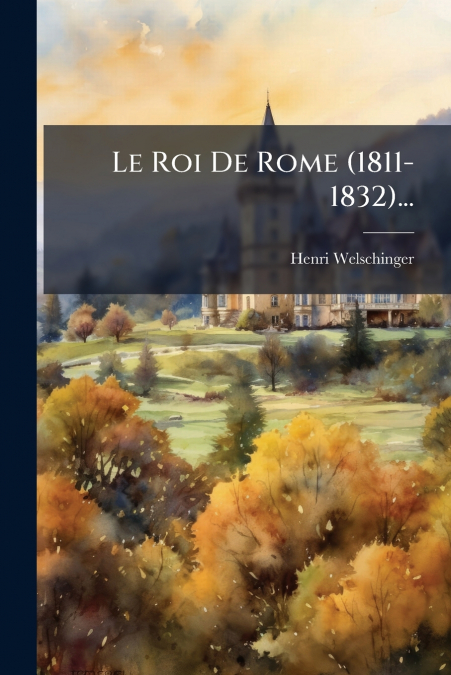
Explore the short and tragic life of Napoleon II, the only son of Napoleon Bonaparte and Marie Louise of Austria, in Henri Welschinger’s meticulously researched biography, 'Le Roi De Rome (1811-1832).' This book delves into the political and personal circumstances surrounding the young Napoleon’s upbringing, following his journey from his birth as the King of Rome to his eventual confinement and early death in Vienna. Welschinger paints a portrait of a child caught in the crosscurrents of European power, a symbol of Bonapartist hopes, and a pawn in the hands of emperors and diplomats.This historical account offers insights into the post-Napoleonic era, shedding light on the dynastic ambitions and the complex relationships that shaped the fate of a young prince destined to inherit a legacy that would never be his. A poignant exploration of a life marked by both privilege and profound loss, 'Le Roi De Rome (1811-1832)' is essential reading for anyone interested in Napoleonic history and the lives of European royalty.This work has been selected by scholars as being culturally important, and is part of the knowledge base of civilization as we know it. This work was reproduced from the original artifact, and remains as true to the original work as possible. Therefore, you will see the original copyright references, library stamps (as most of these works have been housed in our most important libraries around the world), and other notations in the work.This work is in the public domain in the United States of America, and possibly other nations. Within the United States, you may freely copy and distribute this work, as no entity (individual or corporate) has a copyright on the body of the work.As a reproduction of a historical artifact, this work may contain missing or blurred pages, poor pictures, errant marks, etc. Scholars believe, and we concur, that this work is important enough to be preserved, reproduced, and made generally available to the public. We appreciate your support of the preservation process, and thank you for being an important part of keeping this knowledge alive and relevant.