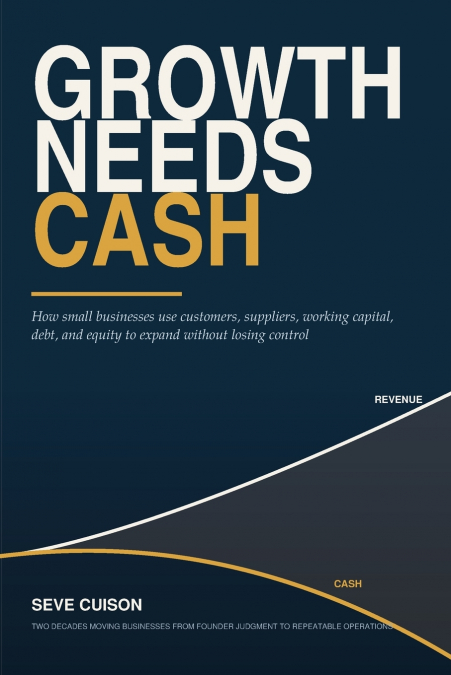
Seve Cuison
Growth can be profitable on paper and still damage the business that pays for it.A larger order, a second location, new equipment, added inventory, or an acquisition may look financially attractive-until payroll, supplier payments, construction costs, and delayed collections begin consuming cash long before the new revenue arrives.Growth Needs Cash is an operator’s field guide to financing expansion without starving the business that already works. It explains how small-business owners can determine the complete capital requirement behind a growth plan, identify who is actually financing it, and understand the obligation attached to every source of money.Through practical frameworks, worked calculations, and the continuing case of Northline Specialty Services, the book shows how:Reported profit can overstate the cash a business can safely investA visible opening budget can conceal a much larger operating-ramp requirementCustomer deposits and supplier credit function as financingWorking-capital improvements can release cash without adding debtLoans, guarantees, and equity affect both risk and controlHidden support from the original business can make a weak expansion appear successfulCapital can be released in stages as evidence improvesManagement can protect the core business while still pursuing growthNorthline reports $320,000 in profit, yet only about $70,000 remains economically repeatable after the business accounts for founder labor, replacement management, deferred maintenance, and shared support. Its apparent $640,000 expansion budget eventually becomes a complete capital requirement of $1.02 million.Those gaps are not accounting technicalities. They are where growth plans succeed, stall, or quietly weaken the company financing them.Written for owner-operators, entrepreneurs, managers, advisers, and lenders, Growth Needs Cash provides a disciplined method for expanding without confusing capital availability with financial readiness.Every growth plan has a financier. The question is whether the obligation is understood before the money is committed.