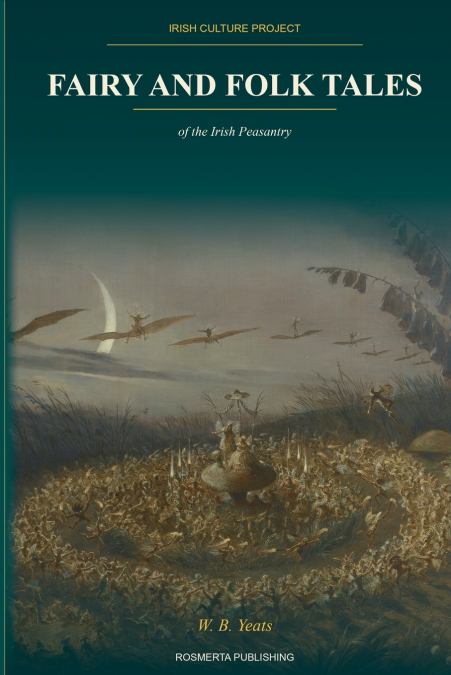
W. B. Yeats
W. B. Yeats was twenty-three when this book appeared in 1888, and it was the first he edited. He was not yet the poet of the later work. He was a young man convinced that the stories still being told in Irish cottages were not quaint survivals but a living literature, and that nobody had yet presented them as one.So he went to the collectors. Thomas Crofton Croker, who had gathered fairy legends in Munster sixty years before. William Carleton, who had grown up inside the tradition and written it from the inside. Douglas Hyde, translating literally from the Irish. Lady Wilde, Samuel Ferguson, William Allingham, Patrick Kennedy, Letitia MacLintock, Ellen O’Leary, Gerald Griffin. Yeats took sixty-four pieces from them and did something none of them had done: he organised the material by kind.The result is a taxonomy of the Irish otherworld. The trooping fairies who move in companies. The solitary fairies, the lepracaun and the cluricaun and the far darrig, each with its own temper. Changelings. The merrow of the sea. The pooka in his black horse shape. The banshee, who cries for the old families. Then ghosts, witches and fairy doctors, Tir na nOg, saints and priests, the devil, giants, and the kings and robbers of the later tales.Between the sections Yeats writes. He introduces each class of being, weighs his sources against one another, and sets down what he was told himself by an old man in County Sligo and a pilot at Rosses. His footnotes argue. His closing Notes are a working bibliography of Irish folklore as it stood in 1888. This apparatus is the reason the book has never really been replaced.This edition reproduces the Walter Scott text of 1888 in a fresh typeset, with Yeats’s Introduction, section headnotes, footnotes and Notes preserved in full. Each tale carries the name of the collector who recorded it, as Yeats printed it, so a reader can see at a glance that Teig O’Kane came through Douglas Hyde and The Priest’s Supper through Croker. A closing glossary covers the Irish beings, terms and places the tales use without stopping to define them, with the Irish forms set beside Yeats’s Anglo-Irish spellings.It sits alongside The Irish Fairy Book in the Irish Culture Project. That volume is Alfred Perceval Graves’s selection of 1909. This one is Yeats’s of 1888, a different editor, a different selection, and a running commentary that is his alone.Part of the Irish Culture Project from Rosmerta Publishing.