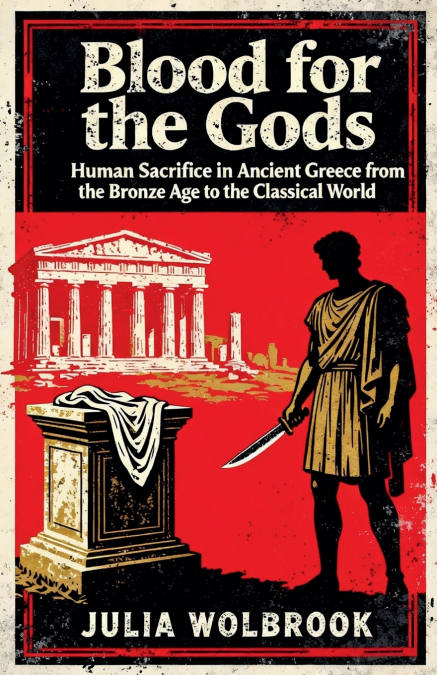
Inicio > Humanidades > Filosofía > Historia de la filosofía occidental > Filosofía occidental: antigua, hasta c. 500 > Blood for the Gods Human Sacrifice in Ancient Greece from the Bronze Age to the Classical World
Blood for the Gods Human Sacrifice in Ancient Greece from the Bronze Age to the Classical World

Blood for the Gods Human Sacrifice in Ancient Greece from the Bronze Age to the Classical World

Julia Wolbrook

13,32 €
IVA incluido
Disponible
Editorial:
Serena Capuozzo
Año de edición:
2026
Materia
Filosofía occidental: antigua, hasta c. 500
ISBN:
9798233613449
13,32 €
IVA incluido
Disponible
Añadir a favoritos

Did the ancient Greeks-celebrated as the founders of Western rational thought-once offer human lives to their gods?For centuries, the idea of human sacrifice in ancient Greece has been dismissed as myth, metaphor, or foreign slander. Blood for the Gods challenges this long-held assumption with a bold, evidence-driven reexamination of one of the most unsettling aspects of Greek religious history.Drawing on literary sources, comparative anthropology, and newly emerging archaeological data, this book traces the development of human sacrifice in Greek cultures from the Late Bronze Age through the end of the Classical Period. It explores not only whether such rituals occurred, but how the Greeks themselves understood and justified them-from heroic myths and ritualized violence to moments of moral tension and cultural unease.Moving beyond sensationalism, Blood for the Gods situates Greek practices within a wider eastern Mediterranean and Aegean context, revealing the complex web of cultural exchange, migration, and religious influence that shaped ritual behavior across the ancient world. By examining potential origins and transmission routes, the book offers a compelling explanation for how and why these rites emerged-and why they ultimately faded.Provocative, meticulously researched, and deeply engaging, Blood for the Gods invites readers to confront the darker edges of Greek antiquity and reconsider what 'civilization' meant in the ancient world.Perfect for readers interested in:· Ancient Greek religion and ritual· Human sacrifice and ritual violence· Bronze Age and Classical history· Myth, archaeology, and cultural exchange· The darker foundations of Western civilizationThis is not the Greece of marble statues and philosophical ideals-but the Greece where blood, belief, and the divine were sometimes inseparable.

Artículos relacionados

  • The Nature of Things
    Lucretius Lucretius
    De rerum natura (On the Nature of Things) is a 1st century BC didactic poem by the Roman poet and philosopher Lucretius with the goal of explaining Epicurean philosophy to a Roman audience. Lucretius presents the principles of atomism; the nature of the mind and soul; explanations of sensation and thought; the development of the world and its phenomena; and explains a variety o...
    Disponible

    36,76 €

  • Pompeii
    Fergus Mason
    Pompeii was one of most advanced cities of its time; it had a complex water system, gymnasium, and an amphitheater. Despite it's advancements, there was one thing it wasn't ready for: Mount Vesuvius—the volcano that led to its ultimate doom.  The 79 AD eruption of Mount Vesuvius was one of the worst disasters in all of European history. In a near instant, over 15,000 p...
    Disponible

    10,36 €

  • Middle Platonism and Neoplatonism, Volume 1
    Stephen Gersh
    'It is generally agreed that those types of philosophy that are loosely called ’Platonic’ and ’Neoplatonic’ played a crucial role in the history of European culture during the centuries between antiquity and the Renaissance. However, until now no scholar has attempted to describe the evolution of these forms of thought in a single comprehensive academic study.' So writes Stephe...
    Disponible

    179,17 €

  • Middle Platonism and Neoplatonism, Volume 2
    Stephen Gersh
    It is generally agreed that those types of philosophy that are loosely called 'Platonic' and 'Neoplatonic' played a crucial role in the history of European culture during the centuries between antiquity and the Middle Ages. However, until now no scholar has attempted to describe the evolution of these forms of thought in a single comprehensive academic study. Middle Platonism a...
    Disponible

    215,18 €

  • Porphyry’s Commentary on Ptolemy’s Harmonics
    Andrew Barker
    ...
    Disponible

    77,17 €

  • The Roots of Platonism
    John Dillon
    ...
    Disponible

    25,29 €

Otros libros del autor

  • Stonewall Made Lee The Truth Behind Robert E. Lee’s Victories and His Failure at Gettysburg
    Julia Wolbrook
    Robert E. Lee is one of the most iconic-and mythologized-figures in American history. Celebrated in Southern memory as the embodiment of honor, courage, and leadership, Lee has long been the centerpiece of the 'Lost Cause' narrative. Yet behind the legend lies a complex truth: Lee’s greatest victories were not achieved in isolation.In Stonewall Made Lee, historian [Your Name] d...
    Disponible

    14,42 €

  • Sacred Rituals Human Sacrifice in Maya, Aztec, and Inca Societies
    Julia Wolbrook
    What compelled some of the world’s most sophisticated civilizations to offer human lives to their gods?In Sacred Rituals, Julia Wolbrook delivers a meticulously researched and intellectually compelling exploration of human sacrifice in the Maya, Aztec, and Inca worlds. Moving beyond sensationalism, this book situates ritual killing within the broader spiritual, political, and c...
    Disponible

    14,47 €

  • The Weak Redcoats Why the British Army Failed at Lexington and Concord
    Julia Wolbrook
    Why did the most powerful army in the world falter against a scattered colonial militia on April 19, 1775? In The Weak Redcoats, this gripping and revisionist study dismantles the myth of British military invincibility. It reveals how structural weakness-not colonial luck-shaped the outcome at Lexington and Concord.Drawing on battlefield reports, officers’ correspondence, logis...
    Disponible

    13,34 €

  • Omaha Beach
    Julia Wolbrook
    June 6, 1944.Along a narrow stretch of sand on the coast of Normandy, the fate of the Allied invasion of Europe hung by a thread. Omaha Beach-meant to be one landing zone among many-became the most lethal battlefield of D-Day and one of the defining crucibles of the Second World War.Omaha Beach: Triumph and Tragedy on D-Day offers a vivid, unflinching account of America’s blood...
    Disponible

    15,51 €

  • Jonestown Was Inevitable Cold War Paranoia, Cult Fear, and the Making of America’s Most Infamous Massacre
    Julia Wolbrook
    In Jonestown Was Inevitable, a gripping and unsettling reexamination of one of America’s most infamous tragedies, this book challenges everything we think we know about the Jonestown Massacre. Rather than treating it as the result of blind obedience or collective madness, this deeply researched narrative reveals how Cold War paranoia, fear of social outsiders, and media-fueled ...
    Disponible

    15,51 €

  • A Special Relationship Mackenzie King, Franklin Roosevelt, and the Making of Modern Canada-U.S. Relations
    Julia Wolbrook
    How did two unlikely leaders reshape the destiny of North America and forge one of the world’s most enduring international partnerships?In A Special Relationship, acclaimed statesman William Lyon Mackenzie King and charismatic American president Franklin D. Roosevelt emerge as the central architects of modern Canada-United States relations. Against the backdrop of economic coll...
    Disponible

    15,38 €