Ty Keynes
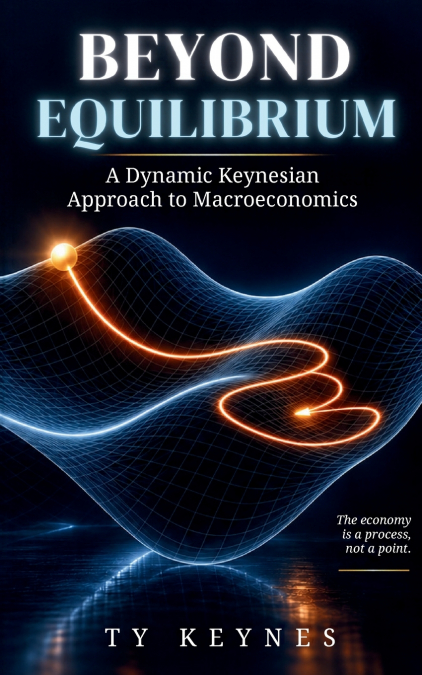
What happens when we stop assuming where the economy is going and start asking how it actually gets there?Beyond Equilibrium develops a dynamic approach to Keynesian macroeconomics built around feedback, accumulation, expectations, and adjustment through time. Rather than beginning from equilibrium, the book constructs the economy from familiar Keynesian mechanisms and asks what behavior emerges when they are connected.Consumption responds to income. Investment responds to expectations, profitability, capacity, and interest rates. Firms accumulate inventories. Employment responds to production. Wages and prices adjust. Governments tax, spend, issue debt, and pay interest. Central banks change interest rates. Trade connects the domestic economy to the rest of the world.Individually, these relationships are familiar. Connected together, they can produce something much richer: growth, overshooting, oscillation, instability, and changing patterns of feedback.Using a Post-Keynesian System Dynamics model, Ty Keynes shows how stocks give the economy memory, how delays can turn stabilizing responses into oscillations, why the same shock can produce different outcomes under different conditions, and how policies can change the very system they are attempting to stabilize.The book also explores the Lucas critique, adaptive 'Macrofoundations,' the interaction between monetary policy and government interest payments, and the role private credit and debt could play in a future extension inspired by Steve Keen.Beyond Equilibrium is ultimately an argument for studying the economy as an evolving system rather than a sequence of equilibrium states.The destination matters. But so does the path.