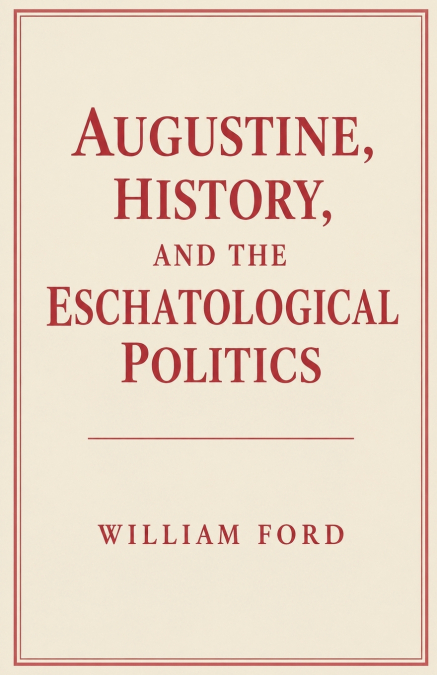
Augustine, History, and the Eschatological Politics

Augustine, History, and the Eschatological Politics

William Ford

23,34 €
IVA incluido
Disponible
Editorial:
Colloquium
Año de edición:
2026
Materia
Filosofía occidental: antigua, hasta c. 500
ISBN:
9798237416404
23,34 €
IVA incluido
Disponible
Añadir a favoritos

Few figures in the history of Christian thought have exercised a more enduring influence on the understanding of history, politics, and the destiny of human societies than Augustine of Hippo. Writing during the final decades of Roman imperial predominance in the West and amid the profound uncertainties that accompanied the transformation of the ancient world, Augustine confronted questions that had become unavoidable for educated Romans and Christians alike. Why do empires rise and fall? What meaning, if any, can be discerned within the apparently chaotic succession of historical events? Can political communities participate in a divine purpose unfolding through time? Is history moving toward a fulfillment that may be realized within earthly institutions, or does ultimate redemption lie beyond every human order? Such questions pressed upon Augustine with particular urgency after the sack of Rome in 410, but they had been forming throughout centuries of intellectual, religious, and political development. His response would become one of the most influential interpretations of history ever produced in late antiquity. This book examines Augustine’s reflections on history and politics through the lens of what may be called eschatological politics. By this phrase is meant any attempt to identify a particular political community, empire, regime, or institutional order with the realization of humanity’s ultimate destiny.

Artículos relacionados

  • The Nature of Things
    Lucretius Lucretius
    De rerum natura (On the Nature of Things) is a 1st century BC didactic poem by the Roman poet and philosopher Lucretius with the goal of explaining Epicurean philosophy to a Roman audience. Lucretius presents the principles of atomism; the nature of the mind and soul; explanations of sensation and thought; the development of the world and its phenomena; and explains a variety o...
  • Pompeii
    Fergus Mason
    Pompeii was one of most advanced cities of its time; it had a complex water system, gymnasium, and an amphitheater. Despite it's advancements, there was one thing it wasn't ready for: Mount Vesuvius—the volcano that led to its ultimate doom.  The 79 AD eruption of Mount Vesuvius was one of the worst disasters in all of European history. In a near instant, over 15,000 p...
    Disponible

    10,36 €

  • Middle Platonism and Neoplatonism, Volume 1
    Stephen Gersh
    'It is generally agreed that those types of philosophy that are loosely called ’Platonic’ and ’Neoplatonic’ played a crucial role in the history of European culture during the centuries between antiquity and the Renaissance. However, until now no scholar has attempted to describe the evolution of these forms of thought in a single comprehensive academic study.' So writes Stephe...
  • Middle Platonism and Neoplatonism, Volume 2
    Stephen Gersh
    It is generally agreed that those types of philosophy that are loosely called 'Platonic' and 'Neoplatonic' played a crucial role in the history of European culture during the centuries between antiquity and the Middle Ages. However, until now no scholar has attempted to describe the evolution of these forms of thought in a single comprehensive academic study. Middle Platonism a...
  • Porphyry’s Commentary on Ptolemy’s Harmonics
    Andrew Barker
    ...
    Disponible

    80,87 €

  • The Roots of Platonism
    John Dillon
    ...
    Disponible

    26,54 €

Otros libros del autor

  • Apocalyptic Preaching and the Political Imagination in the Middle Ages
    William Ford
    Few themes exercised a more profound influence upon the medieval imagination than the expectation of the end of history. Throughout the Middle Ages, men and women interpreted wars, epidemics, famines, dynastic conflicts, ecclesiastical controversies, and natural disasters through narrative frameworks drawn from sacred scripture. The language of apocalypse was not confined to mo...
    Disponible

    23,25 €

  • Scholastic and University Preaching in the Middle Ages
    William Ford
    Among the many institutions that shaped medieval European civilization, none exercised a more profound influence upon the formation of religious thought and intellectual culture than the schools and universities that emerged between the twelfth and fourteenth centuries. At the same time, few instruments proved more effective in disseminating ideas, doctrines, values, and theolo...
    Disponible

    18,52 €

  • History of Medieval Sermons on the Books of the Old Testament
    William Ford
    The history of medieval sermons on the books of the Old Testament occupies a central yet often underappreciated place within the study of medieval Christianity. For more than a millennium, Christian preachers across Europe turned repeatedly to the narratives, prophecies, laws, prayers, and wisdom traditions of the Hebrew Scriptures in order to instruct, admonish, inspire, and g...
    Disponible

    18,48 €

  • Political Preaching and the Artes Praedicandi in the Middle Ages
    William Ford
    The political history of the Middle Ages has long been written through the study of kings, princes, councils, wars, laws, and institutions. Equally influential, however, were the words that echoed from pulpits in cathedrals, parish churches, monastic houses, universities, and urban squares. Medieval politics unfolded not only in courts and chancelleries but also in sermons. The...
    Disponible

    18,06 €

  • Peter Abelard’s Intellectual Journey and the Rise of Reason in the Middle Ages
    William Ford
    The story of medieval thought is often told as if it were a long night between the brilliance of antiquity and the dawn of modernity, a period supposedly marked by intellectual stagnation and unquestioning obedience. Yet nothing could be further from the truth. The Middle Ages, especially the centuries surrounding the life of Peter Abelard, were a time of extraordinary intellec...
    Disponible

    16,18 €

  • The Role of Conciliar Canons in Shaping Ecclesiastical Identity in the Middle Ages
    William Ford
    The history of the medieval Church is, in many ways, the history of its norms. Across more than a millennium, councils gathered bishops, abbots, theologians, and occasionally secular rulers to deliberate on matters of doctrine, discipline, and governance. The canons they produced-concise, authoritative statements intended to regulate belief and behavior-became some of the most ...
    Disponible

    16,15 €