Martin Foster
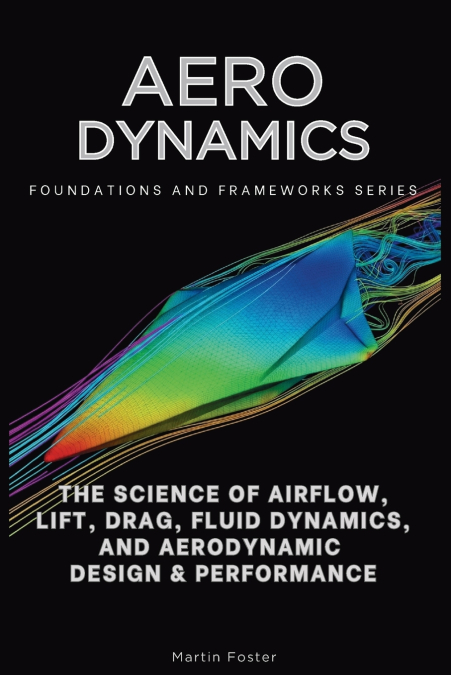
Aerodynamics explained in plain language, starting with the physics of air and ending with the wings, rotors, race cars, and bridges that depend on it. Learn why things fly, stall, stick to the track, or shake apart in the wind. Ten chapters build the subject in order. Each one starts from the properties of air, adds the governing equations, and then applies them to real machines, with summary tables, worked numbers, and clear notes on where each model holds and where it breaks down. The reason shows up early: a 1934 calculation famously claimed bumblebees shouldn’t be able to fly, and the error came from choosing the wrong model. Topics by chapter: - Air as a fluid: density, pressure, viscosity, the standard atmosphere, and what Reynolds and Mach numbers tell you about any flow - Navier-Stokes, boundary layers, and vortex streets - How lift really works, with the equal-transit-time myth set straight, the Kutta-Joukowski theorem, thin airfoil theory, stall, and the Magnus effect - Skin friction, induced drag, wingtip vortices, and the winglets built to fight them - Finite wing theory with sweep, taper, and twist, followed by flaps and slats, longitudinal and lateral stability, control surfaces, trim, the flight envelope, and the numbers behind range, endurance, climb rate, and glide ratio - Transonic to hypersonic flow: shock waves, the area rule, sonic booms, reentry heating - Propellers, helicopter rotors, wind turbines and the Betz limit, plus drones, birds, and insects - Road cars, trucks, trains, and Formula 1 machines, covering Kammback tails, diffusers, ground effect, dirty air, and DRS, then wind tunnels, CFD, skyscrapers, bridge flutter, and golf ball dimples Who will get the most from it: - Engineering and physics students who want a readable companion to coursework - Student pilots working through ground school - Motorsport fans, drone builders, and engineers moving into a new field - Curious adults who want real answers rather than hand-waving You don’t need an engineering degree. Every equation appears in plain text with an explanation of what it says and why it behaves the way it does, and most need only algebra. Each chapter ends with questions that ask you to apply the material, and example responses at the back let you check your reasoning. A historical timeline runs from Bernoulli’s Hydrodynamica in 1738 through the Wright brothers’ homemade wind tunnel and Chuck Yeager’s Bell X-1 flight, and a glossary, reference list, and recommended readings close out the book. Real cases fill the pages: the 1940 Tacoma Narrows collapse, the Phoenix heat wave that grounded regional jets, the Burj Khalifa’s stepped profile, and the robotic fly wings Berkeley researchers flapped in a tank of mineral oil. Once you hit the last page, the rear wing on a sports car, the bent-up tips on an airliner, and the dimples on a golf ball will look like decisions you can explain.