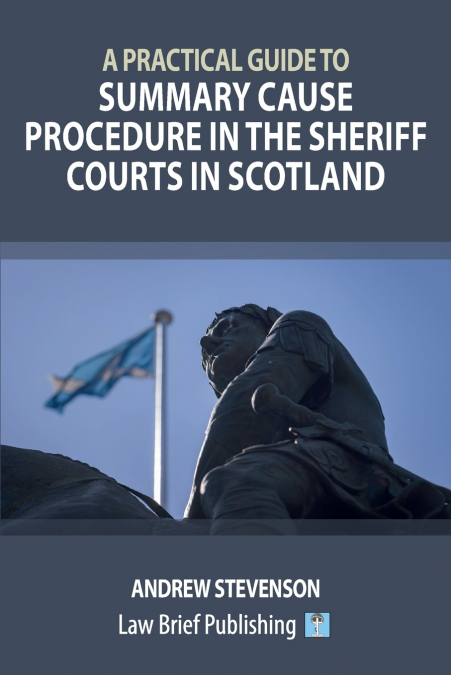
Andrew Stevenson
This is a practical guide to conducting a proof in the sheriff court, based on the author’s many years’ experience of presenting evidence at proofs and hearings in the sheriff court, the Court of Session and before tribunals. It highlights the importance of risk management in an area of law that is fraught with hazards concerning costs, timescales and adverse outcomes. It also identifies many useful steps that ought to be taken with a view to minimising such hazards and making the process of conducting a proof as smooth and as painless as possible.The book is aimed primarily at practitioners and deals with managing clients, advice on preparation and how best to cover one’s back in this perilous area of legal practice. Although reference is made to court rules and textbooks the book is first and foremost a practical guide.In this Second Edition, the author takes accounts of the settling of the dust after Covid-19, the spread of the use of affidavit evidence and the rise of Artificial Intelligence.CONTENTS1: Introduction2: Risk Management, Forum Shopping and Legal Aid3: Capacities, Officers of the Court and Party Litigants 4: Acting as Agent for a Litigant or for Another Solicitor5: The Solicitor’s Personal Responsibility for Outlays6: Risk Management: How to Avoid Having to Conduct a Proof7: Before the Proof Date Is Assigned8: Affidavits9: Managing the Evidence That Is Needed at a Proof10: Intimating and Lodging Lists of Documents, Witnesses, Affidavits and Productions11: Practical Advance Steps to Make Life as Easy as Possible on the Day12: Using Evidence at the Proof; Witnesses13: Calling Witnesses14: Credibility Versus Reliability and Objecting to the Opponent’s Questions15: Cross Examination16: Judicial Knowledge, and the Law of Evidence17: Running a Hopeless Proof, and the Post Mortem Where a Proof Is LostConclusion and Bibliography